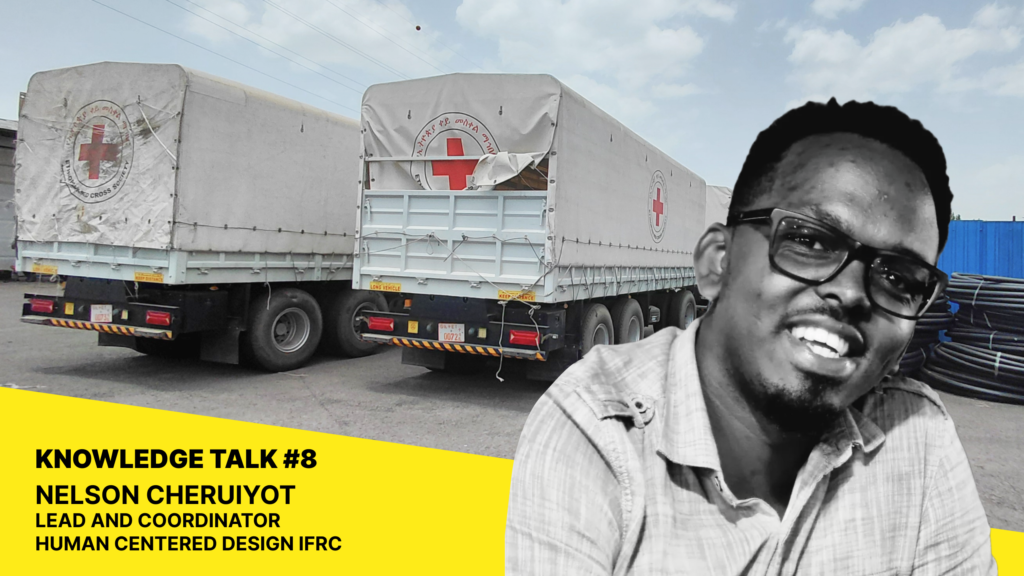
Nelson Cheruiyot, Lead and Coordinator Human Centered Design at IFRC – HD Knowledge Talk #8
- Knowledge Talks
Introduction
We welcome Nelson Cheruiyot, currently based in Nairobi, Kenya, where he serves as Lead and Coordinator of Human-Centred Design at @ifrc During his design journey, Nelson has also worked with PATH and ICRC, applying human-centred design to humanitarian, health, and social impact challenges.
In this session, he will share insights from leading design and innovation initiatives across organisations, and reflect on how co-creation and community-centred approaches can help shape more effective and sustainable humanitarian solutions.
Resources
Transcript
Introduction
Nelson CK is the lead and coordinator for human-centred design at the International Federation of the Red Cross and Red Crescent Societies (IFRC), the secretariat supporting 191 national societies across the globe. With a background in interior design, he transitioned into human-centred design through health systems work, living labs, and innovation, before building design teams at the ICRC and now leading design strategy at the IFRC. In this talk, he will share how his understanding of design has evolved over the years, from facilitation to influence to strategy, and walk through the tensions he navigates daily when practising human-centred design in humanitarian settings: speed versus participation, innovation versus accountability, evidence versus intuition, and how to embed design into organisations that can easily cut it when budgets shrink. He will then reply to questions from the community members of Humanitarian Designers.
The Bicycle That Changed Everything
Misha: Hello, everyone. Thank you for joining on this sunny, I hope for you, day. Today I think we will have another very interesting discussion. Today we have Nelson, who works at the International Federation of the Red Cross and Red Crescent Societies. We’ve been planning this for quite a long time. I think the first time we spoke was more than a month ago, so I’ve been waiting for this. The plan is to have roughly 40 to 45 minutes of Nelson talking and then the rest for questions. Having said that, I think you can kick it off.
Nelson: Hi everyone. It’s a pleasure to meet you. My name is Nelson and, as Misha described, I am currently the lead and coordinator for human-centred design at the International Federation of the Red Cross and Red Crescent Societies. Just a short introduction: the IFRC is the secretariat of about 191 registered national societies across the globe. We coordinate a lot of the activities across the national societies and support them during disaster response and in various ways. Although, for us to know, national societies are independent institutions. The IFRC just plays a secretariat role, supporting and guiding whenever, wherever the national society needs help. I’ve been in this role for about 11 months, but I’m not new to design. I will walk you through my journey, and this talk has also been an introspection for me in how I’ve been thinking about design. So I’m glad I got the opportunity to self-reflect as I prepared.
My journey as a human-centred designer began more than a decade ago. My design journey began as an interior designer, so that is what my undergraduate studies focused on. If I lose a job, I’ll be designing kitchens and living rooms. But I got triggered at a point where we were with this organisation and the question was what design can do. It was quite an eye-opener for me that you can actually apply design beyond designing spaces and experiences. You can actually help solve problems using design. I think that has been the journey for most of us designers.
But a pivotal moment was one of the studies I was doing earlier on that led me to a health facility in the western part of Kenya. The project was on improving the motivation of frontline healthcare providers in immunisation, with the scope limited to simple solutions. I sat in the waiting area of a health facility, and there was a black bicycle that was still wrapped and dusty. I looked at the nurse, who of course was not using the bicycle, and I simply asked, “What is this bicycle doing here?” It is not something I would expect inside a healthcare facility, in an office. And she said, and we captured that verbatim: “Sometimes we’re given things that we don’t need”.
That struck me to the core and shifted something in my mind. At that point, I was just doing the design process: you begin with empathise, you go through the entire design process. But it shifted something in me. I started thinking about how we can improve how other people see our users, how organisations, institutions, governments engage with end users. The bicycle was there because there was a programme at the local government where they were incentivising healthcare providers, and they provided this bicycle. Was this healthcare nurse in her 50s going to use a bicycle? No. Was the intention good? Yes. And clearly those are mismatched.
Design Tensions in Humanitarian Settings
Nelson: However, this has not been easy for me. I found myself at the onset of setting up design practices across different organisations, and I put together some of the tensions that have come across, especially now in a humanitarian setting.
The first one is speed and participation. For some reason, non-designers, when they think about design, they feel that it takes time. “Am I going to do a two-week sprint? Am I going to pause everything and allow you to come in and do your design work?” Then you’re met with a context where there’s urgency. Right now, there’s a lot of support going to the DRC because of Ebola. We would want to have this engagement with nationals, with locals, with the national society, to understand some of their needs. However, I don’t think anyone is going to pause for us to do this work because Ebola is a real, active, life-threatening context. So the question we now begin to ask is: how much participation is enough when time is limited, resources are limited, or contexts are constrained? Because of the nature of the response, not everyone would be allowed to go to the national society. You might have a national society with very low connectivity, so even virtual engagements could be limited. How do you apply human-centred design in this context?
The next one is innovation and accountability. In a humanitarian environment, the principle of “do no harm” is paramount. However, sometimes when you go through design processes, there is the notion that we want to learn fast through experimentation, prototype testing. How do we do this with people seeking assistance who are quite vulnerable, because some of the products are geared for them? At the same time, knowing that if there is a risk, it actually harms a human being, it outrightly bars them from receiving care or support, or it might create a negative image about the Red Cross, Red Crescent. I’ve learned a few things. We’re beginning to test in more stable environments. We’re setting up a national society sounding board where we have a pool of national societies that would be ready and willing to test some of our solutions. Internally, how do we not prevent the disruption of critical processes, critical workflows, through design?
One of the landings I had when I was excited, back when I was very excited and young: I believed I was a superstar, the guy who’s come to solve all the problems of the organisation. Understanding how people perceived me quite literally humbled me. “Are you the designer?” And design in some of these contexts is not limited to human-centred design; it’s actually limited to graphic design, the first interaction with what design is. It becomes very difficult to engage with this kind of mindset, especially where we need their participation and buy-in.
The other tension is evidence versus intuition. Organisations trust hard metrics: how many people are we able to support day in, day out. We have all these dashboards. Whereas in design, we also trust the observations we make, and sometimes these observations are very difficult to quantify. How do we show the business value of design? How do we communicate qualitative insights and pair them with quantitative evidence so that decision-makers can make informed choices?
This is a tension I’ve lived with as long as I’ve practised design: being able to observe sometimes firsthand what people need, especially in hard-to-reach areas. Sometimes when you go there, you look at these dire contexts and you want to leave your money, you want to empty your bank account and give them everything, including the clothes and shoes you have, because of what you’re seeing them go through. And you identify an actual need, but the organisation you’re working for does not have the resources to meet these needs, either in terms of scope or resources. Internally, it begs the question: did we have to engage with them? Because ethically, we are almost promising them that we’ll be able to solve some of these issues, and then finding out that you cannot. How do we handle this helplessness? How do you apply good design within real-world constraints?
Building Human-Centred Organisations
Nelson: So my mind has shifted over time. One of the things that changed is moving beyond human-centred design as project support to designers as organisational capacity. This is a critical phase as you start or participate in organisations whose design maturity is really low, or where design capacity is limited to project support, or confined at a lower level in terms of influence. If an organisation understands the value of design, it is more likely to make human-centred informed decisions. But that doesn’t come easily. We need to walk beyond producing the artefacts we come up with, into informing strategic directions at the leadership level.
At some point, I was keen on building design teams. Design teams are great, but design teams also unfortunately suffer as the first batch of people when resources are constrained. I’ve gone through this a lot, where when there’s a lack of resources, they look at the design team and we are very easily let go. I’ve seen this across multiple organisations, even within the Red Cross, Red Crescent movement. We’ve had surges in designers and then the next year lost about 50% of them, while other teams remained the same. We are perceived as this team of young people who dress and talk differently and are very excited, and the organisation perceives that it can actually do without design. That’s the communication it sends.
Now I’m trying to figure out how to build more human-centred organisations, to embed the fabric of what human-centredness is into the organisation. Some of the ways we’ve been able to ensure this is embedded: looking at processes and including or decentralising the design process so that you have design where you need it, and then step back when you’re not necessarily needed. For instance, using a lightweight approach in your intake process for any solution, a very light way of ensuring that solutions go through the design process without having to call it the design process.
Another way is defining what other activities would benefit more from an understanding of who we are trying to serve. For instance, if you’re working with people seeking assistance, how do you present this information to product managers, programme coordinators, in a way that informs them to make the right decisions? We’ve built personas across the organisation and are ensuring they’re up to date and that anyone can interact with them. We’re building user pools that allow teams to engage much more easily.
This one was hard for me in terms of changing my mind, because I always thought the goal of design is to come up with the best solution. But over time, I’m moving towards designing for complexity. In the humanitarian sector, solutions need to be context-aware. In a response, you have the person needing support, the volunteer providing support, the national society overlaying over the volunteer, then the Federation, and other organisations coming in. Your solution needs to be able to absorb and adapt to all these changing complexities over time. We’ve seen really good solutions fail, and they’ve been expensive failures. Now we’re beginning to question some of the observations we’ve made over time: the disuse of solutions, feelings around ownership of digital tools, the participation of national societies in the development of solutions. The best solution may not necessarily be the solution that needs to be in place. We need to ensure that the solutions we come up with adapt to complexity.
I began this by telling my story about the bicycle and the healthcare provider. Empathy for me was the heart of design, but as I’ve gone across organisations, it’s moving not just from empathy to influence: how can we use design to influence strategy, policy, funding priorities, product decisions? How can design be the voice that allows leadership to make informed decisions? We know what our users need. How do we get organisations to move towards what these users actually do need? It’s not been easy, but it’s also been quite liberating when an organisation starts to move in this direction.
For instance, I’m setting up a market research engagement trying to understand what our national societies need and then matching that against what our support has been. The goal is to influence the strategy that the IFRC has towards providing digital support to national societies. For me, that is a win. I’d be very grateful for our product teams to be more human-centred compared to me fighting to have ten other designers. Because I know when the budget cuts come, they’re going to come for the designers, and at that point you lose the human-centredness of the organisation. So how do we build it in? That has been one of my tasks at the moment: to build capacity across the organisation, across different levels, so that it’s not just a way of doing but also a way of thinking that is processed through the leadership.
Questions & Answers
Question: finding allies across the movement
Cedric: Thank you for the presentation. It’s very interesting to see the evolution towards more strategic and more leadership and how you navigate that within the organisation. I’m wondering, because you are working for the IFRC, which is a federation, are you able to find allies? People who understand what design is, who can bring that conversation to the decision level, at any level basically. Are you able to find those allies that are also part of the movement, at the IFRC, ICRC, or others?
Nelson: Yes. I’ve established a design community of practice in the Red Cross Red Crescent movement. At the moment, we have about 10 designers actively participating as part of national societies and the ICRC. I know there are some I have not reached yet, like the American Red Cross. I have connections with them, but I’ve not invited them yet. These allies also build towards a shared practice. One of our goals is to publish a kit for national societies to be able to adopt human-centred design, knowing that they may well not have the resources to employ human-centred designers, but also just to build capacity among high-level leadership on how they can move towards being more human-centred. We have a growing community. Growing and shrinking, and growing and shrinking.
Cedric: We would be happy to hear their names. Maybe they are future speakers. A few weeks ago, we had Milan Kieffer from the French Red Cross.
Nelson: Yes, from the French Red Cross. Maybe one of the sessions, after summer, we could bring them on. I’m looking at my channel and we’re at 13. It keeps growing as we find each other. It’s been a journey of trying to know who’s doing what, where, at what levels. They’re at different levels. Some are still at project-based or project support level, and others are in teams that have been positioned very well across the movement, like the Netherlands Red Cross 510 team, which has dedicated resources in digital support models. It’s a growing community. We keep finding each other, and it’s also been a place for us to rally together. We had quite some really good ambitions last year, but then with Trump coming in and the funding cuts, we lost a good number of designers. We’ve had to regroup again. And that happens when design is not embedded, when the organisation is not human-centred. It becomes very easy to cut.
Question: types of projects and differences across national societies
Misha: This was somewhat a good segue to my question. As Cedric said, we did have Milan from the French Red Cross not that long ago, and Milan went quite deep into the type of projects they do. People here might be familiar with what Red Cross does, but could you maybe give a couple of examples of what types of projects and initiatives you take part in at the IFRC? And if you can, I know every national society is different, but maybe you could reflect on the difference between the work you do and what they do, for example, and where innovation and design teams sit in the actual Red Cross societies.
Nelson: I’ll give an example. The Netherlands Red Cross has a team called 510. Their specialty is supporting digital products for national societies that enable delivery of assistance. Whether it is cash assistance, for example, they have a platform called the 1-to-1 platform that allows national societies to easily transfer cash to beneficiaries digitally through connecting a national society to a financial service provider. We support them with the UI development, and we support the product the way a product team would work with a designer looking at the UI, experience, workflows.
Then you have other design teams like the British Red Cross design team that also focuses on internal tools and processes: the development of enterprise resource planning platforms, process workflows, logistics, supply chain. So we’re looking at digital tools internally and also support models towards people seeking assistance: how that can be improved at service centres or distribution centres, looking at how beneficiaries flow in and get support, how they flow out, looking at the blockers.
At the Federation, I support a number of things. I support the development of digital tools internally, our ERP systems, various internal tools that allow us to work and operate fully. So there it is both process and product support: UI, UX support. But at the same time, I’m also supporting national society-facing solutions, solutions we provide towards beneficiaries.
For example, if you go to Google Play right now, there is a product called AxesRC. AxesRC is a tool that allows beneficiaries to self-register and matches them to services in their national society. One of the projects I’m supporting is called the Integrated Assistance Platform. What we are hoping to do is provide dignified assistance over time. When we looked at the support we’ve been providing, it has always been fragmented. If you want cash, there’s a product just doing cash. If you want food items, there’s another product or it’s paper-based. You have to register again to get another service. It’s not dignified in the sense that when you look at the user you’re trying to support, their motivation to comply with your process is because it literally stands between them and suffering. They will do whatever you ask them to do. What we are hoping to do is provide dignified support.
For migrants who face some of the greatest challenges as they move across borders, they’re moving across national societies. As they move across these national societies, the processes are very dissimilar. How can we improve that process so that you’re not required to register again as you move across boundaries, and you’re able to verify yourself and get the support you need, and also identify unique needs within a family? I think of AxesRC like Uber: when you move from one country to another, you don’t have to do the registration process again. You just continue receiving the service as long as you’re mapped to the national society.
We are also working in partnership with different national societies. We are not isolated. The Netherlands Red Cross 510 team, for example, we are in weekly calls, daily calls with them. We’re partnering because our goals are the same and users do not differentiate between the different emblems. They just see the Red Cross. So how can we provide more dignified, supportive assistance to national societies?
Another project I’m working on is building the capacity of national societies to identify their gaps and communicate them competitively. Through design, how can we build national societies to be able to say, “This product you’re giving us is not the right one. We need this one. These are the areas where we need more support from the Federation and from partner national societies and from other donors.”
We’re also building peer-to-peer support. There are some national societies doing extremely well and that can support others. How do you build these networks across the movement? Peer influence is really powerful. If a national society sees another using a particular product, service, or process, they’re more likely to adopt it and learn from them as opposed to someone coming to give them something. That’s one of the ways we’re looking at building ownership.
One of my goals is to conduct market research across at least 50 national societies to identify where the gaps are, not just for the sake of knowing, but to be able to introspectively look at the support our leadership has been giving national societies. Are there glaring gaps we’ve been missing? Is what we’re providing only being used by a very small percentage of national societies, giving us a signal that we need to change our strategy in terms of digital support? That’s what I’m celebrating: you have this opportunity to practise design but then also influence the organisation’s strategy.
Misha: So you’re kind of both at the same time: this strategic birds-eye-view thing where you connect other societies, but on the other hand, you’re a tactical team that comes and helps with different projects that are needed.
Nelson: Yes. Helps where needed, yes.
Question: global scale versus local adaptation
Kellen: Hello. Do you have time for a quick two-part question, Nelson?
Nelson: Yes, I have the whole evening today.
Kellen: Good to meet you. Thank you for sharing all the knowledge. I focus more on on-the-ground tools. I’m sitting here thinking the IFRC is massive as an organisation, but human-centred design is hyperlocal. So how do you build tools that are structured enough to scale globally but flexible enough for local volunteers to adapt to whatever unique culture they’re working in?
Nelson: Very good question, Kellen. Some of the things we’re trying to do: we’re building the most basic version of the support, the most basic tools that support the common support models national societies have. When you look at how national societies operate, there is a common pattern: preparedness, when we are engaging with the community; response, the actual delivery of support; and recovery, bringing people back to where they were. When you drill down, there are very basic activities that happen. In all national societies, you have the activity of beneficiary registration where volunteers go out and collect information.
Over time, what we’ve learned is they’ve been using, for example, KoBo, a very widely used data collection tool. What we’ve been doing is integrating KoBo into our system. The volunteers don’t have to change anything. They still maintain their practice. The national society can still build and come up with their questions and forms, and we’re just integrating them into our tools. Once the data has been collected by the volunteer, it automatically is reflected. Some sections remain the same. We maintain the same behaviour, the same patterns, if not improve them. What we’re also learning is that across multiple national societies, the beneficiary registration process is almost standardised: the same questions, same format. So how can we already preconfigure this in our digital tools?
Some of our tools are becoming multilingual so that different countries and languages are able to engage, including some local languages. With AxesRC, we have more than 20 languages. This is allowing more people to use the same tool over and over again. Essentially, what we’re trying to do is find the most common processes and focus on those, then allow national societies to do what they need on top. Once they’ve collected their data, whatever other tools they wish to create is upon them. We build that capacity.
We’re also trying hard not to make digital tools too heavy, requiring more advanced devices. We are sometimes not updating too much, trying to keep our solutions at the most basic level, because we struggle with connectivity, access to devices. It’s not a walk in the park, especially when we think of scale. We’re also trying to allow interoperability across multiple platforms. Some national societies have multiple tools and just need them to connect. National societies are also looking into open-source platforms, building and supporting those. If it works for a number of national societies, it stays the same. We’re also offering multiple platforms for the same service. In South America, one tool is very common, but in Africa, 1-to-1 is the most common. Just being able to provide different options for different contexts.
Kellen: Thank you very much. You answered my second question too.
Closing Remarks
Misha: We did start a couple of minutes later, so if anybody has a burning question, I’ll allow one. I think we’re good. This was fun, as I promised. You are a great presenter, which makes sense since you were building design teams, which is kind of part of your job. I think everybody appreciates that perspective and it’s super interesting to see the strategic birds-eye view on that part. As usual, we will post this to YouTube so everybody will be able to watch it, and everybody who watches can also join the Slack and ask Nelson any other questions. Don’t be a stranger. Having said that, thank you everyone for coming and see you in maybe two, maybe four weeks.