Barbara Sartore, Communications Officer at SOS Humanity – HD Knowledge Talk #7
- Knowledge Talks
Introduction
Barbara is a Communications Coordinator at SOS Humanity and a member of the Head of Mission team onboard the rescue vessel Humanity 1. With a background in human rights and international law, she has worked in humanitarian communications for over 12 years and has been volunteering with search and rescue NGOs in the central Mediterranean since 2023. In this talk, she will share the communication challenges of search and rescue operations at sea, exploring the ethical dilemmas and legal requirements of managing photos, videos, and testimonies when documenting the journeys of people rescued in the Mediterranean.
Resources
Transcript
About Barbara and SOS Humanity
Barbara: Hello, it’s lovely to meet you all. My name is Barbara and I am Italian, born and raised, living in Switzerland. I have an academic background around the topics of human rights and international law, but I very quickly found out early in my career that I was a little bit too creative to focus on the law alone, so I’ve always held positions in communications. I’ve been working in humanitarian NGOs for more than 12 years now. I’m also very passionate about sailing, and one thing led to the other: I started volunteering with search and rescue NGOs in 2023 in the central Mediterranean, which led me to take the job that I currently have, a position as Communications Coordinator with a German NGO called SOS Humanity.
SOS Humanity was founded in 2022. It was originally the German branch of SOS Mediterranee, which you might also have heard about as an NGO working in search and rescue operations in the central Mediterranean. The main mission of these NGOs is to protect the human rights of people who are fleeing persecution, violence, and vulnerability through the Mediterranean Sea.
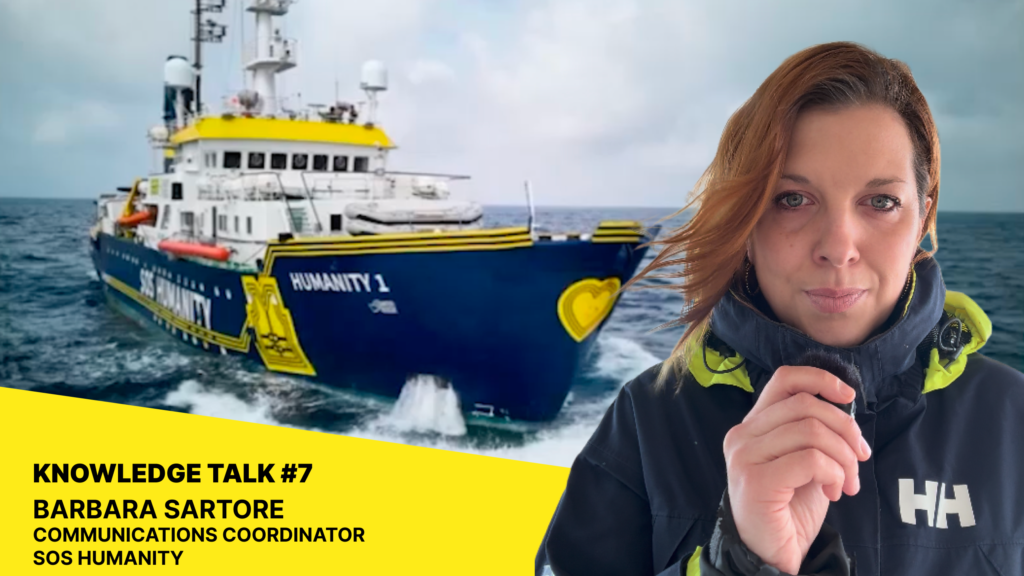
Most of my job, not the only part because I also work on land, but I think the part you’re mostly interested in, is the part where I work on this beautiful vessel that you see here, which is called Humanity 1. It’s a rescue ship operating in the central Mediterranean. We have 29 crew members, some of them permanent employees, some volunteers rotating on a regular basis, and what we do is really focusing on search and rescue operations and providing support to people in distress in the Mediterranean.
A Brief History of Search and Rescue
Barbara: I am not going to go too much into the history of search and rescue because I think we have more interesting topics to talk about, but I just wanted to say to start that crossing the Mediterranean to migrate is something that has happened since the very beginning of time. However, I think it’s mostly in the past 20 to 30 years that we really started seeing people crossing the Mediterranean escaping conflict situations because of the geopolitical situation, especially in North Africa or in the Middle East. People have been increasingly trying to flee conflict, persecution, situations of extreme poverty and getting to Europe by crossing the sea.
What we started seeing more increasingly in the media starting in 2013 is situations of extreme distress. For example, in 2013 there was a very famous shipwreck that killed 600 people, which generated a lot of media attention and prompted the European Union to start Operation Mare Nostrum, an operation mostly managed by Italy that was aiming to find distress cases in the Mediterranean and provide assistance. When that operation came to an end very quickly, after only one year because of the lack of finance, that’s where the NGOs started jumping in to fill this gap and provide assistance to people. We say that the year they started was 2015. That’s a symbolic date, and very sadly, last year we commemorated the 10-year anniversary since the beginning of civilian search and rescue operations in the Mediterranean, which is a very sad anniversary to remember.
Before we delve more deeply into the communications aspect, I just wanted to stress that search and rescue at sea is a legal duty. It’s not just a matter of ethics. It’s not something we do because it’s good and nice to do. It is a legal obligation enshrined in international law, a duty that applies to all ships no matter where they are, in all parts of the world, and it concerns every person in a situation of distress, no matter where they come from, what their religion is, what their nationality is. Everybody has a right to be assisted when they are in distress at sea.
International law also says that whenever you’re in distress and you’re rescued, you must be brought to a place of safety. A place of safety is a place where your life is no longer threatened, but also a place where your basic human needs are met: your necessity for food and shelter and medical treatment, but also a place where you are no longer going to be persecuted. I’m stressing this because there’s a lot of academic consensus and statements from international entities stressing that at this moment in time, Libya and Tunisia cannot be considered places of safety where people are truly protected. This is why you will never see an NGO working in search and rescue operations rescuing a person and taking them back to Libya or Tunisia, because this is not a place where they’re going to be truly protected and where their needs are going to be met.
Communication Challenges at Sea
Barbara: We can now delve a little bit more deeply into the interesting part, and I thought it might be relevant for you as people with a design background to talk about the challenges of having a communication role in the framework of search and rescue operations, especially for people who manage photos and videos as part of their role. There’s a lot of ethical dilemmas and legal requirements that come with it.
I just want to stress that this communication side is something that is really deeply embedded in the mission of SOS Humanity, because what we strive to do as an organisation is not just to save lives, to provide assistance, to protect people, but really also to testify, to document what is happening in the central Mediterranean, the journey that people are taking, the challenges that they experience throughout this journey. Hopefully we do that so that we can influence the public opinion and European institutions and create positive change and change the policies that are affecting them currently.
My Role on Board
Barbara: My role is that of a Communications Coordinator. I’m not the only person having this role. Actually there are three of us on a rotating basis. This is to make sure that at every point in time, there’s one person on board, one person on shore supporting the team on board, and one person who’s taking time off because it’s draining, the time on board. We keep rotating and making sure that the needs are met.
What is really interesting about my role is that when I’m on board Humanity 1, I am a member of the Head of Mission team, and this is a bit special to my organisation. Usually you would have one person being the Head of Mission. We instead have a team of four people, and this is really to make sure that whenever any decision is made on the ship regarding operations, regarding the crew, all of the needs are taken into account, including communication needs. I think that’s really beautiful because it stresses how much communication is taken into account in operations.
I do many things as part of my role. I’m responsible for the audiovisual content production. I’m not the only person in charge of this. I normally have a photographer on board with me and often a journalist who might also take pictures or video, but I am the person who is ultimately responsible for it. I’m also responsible to make sure that everybody on board has access to the information that they need, and I’m also the link between the ship and the team on land.
A bit less interesting, a bit more stressful: I’m also responsible for evidence collection, which means recording all of the emails, all of the phone calls, all the communication that happens between the ship and the authorities. I have a responsibility to make sure that everything is stored for legal purposes and for advocacy purposes. And I’m also a spokesperson and the main media focal point when it comes to journalists.
Core Principles: Do No Harm
Barbara: I thought what would be possibly interesting for you is to delve a little bit more deeply into the complex dilemmas and ethical aspects of managing communications. The main thing, where everything starts from, is the fact that we aim not to do any harm or further harm to the people that we rescue and who come on board. The people we encounter at sea already come from a situation that is usually really difficult. They have suffered human rights abuses, exploitation, they come from a really difficult journey. We do want to document what they go through, but we do not want through our media to create more harm or to trigger more trauma or to awaken really difficult memories. Any time, we have to keep in mind that by the documentation work we do, we may harm these people again, and that should always be in the back of our minds.
Informed Consent and Privacy
Barbara: Another thing that we put a lot of emphasis on in my organisation is informed consent. Whenever a person is recognisable in a picture, whenever we want to use the image of a person in a way that makes them identifiable, we always want to do that with the consent of the person. And not just any consent: a truly informed consent and understanding of what we’re going to be using this picture for, how, when, and where. This is not just a matter of ethics. It’s also a legal requirement we have to comply with.
If I want to take a picture where a person is truly visible in their face or is recognisable through body traits, we are never going to use that picture unless we have talked to the person and asked if they are OK with it. When I say OK with it, I don’t just mean, “Hey, are you cool with me taking a picture?” We really want the person to be truly informed about why we’re doing what we’re doing, when and where we are going to be publishing this picture, what kind of reach it can have, and how long we are going to keep it. We have a proper conversation with the person each time we want to use one of such pictures.
This is extremely delicate because a person coming on board is in an extremely difficult situation. Sometimes they might be just really grateful because they’ve been assisted, and they might feel pressure to say, “Yes, sure, take a picture”, because they’re feeling really thankful for our assistance, not truly understanding what that might mean in the longer term. This is something we are extremely careful about, and we are even more careful when it’s people with a particular vulnerable state, for example children or other people facing a very difficult situation.
Some of the pictures that we take might create risks for the person when they disembark and then apply for asylum or international protection. Those might be used as evidence against them for whatever reason. So we also want to be extremely careful about not putting them in a complex situation.
The other thing you might probably have heard if you follow the media is that for Italian authorities, there’s a policy for which the person caught driving the boat is assumed to be responsible for the smuggling. By experience, we know that this is absolutely not necessarily true. Very often the person driving a boat just found themselves in this situation. Sometimes they get a discount on their fare because they’re driving, or sometimes they just happened to be capable of driving a boat and nobody else was. Because of this policy, we are extremely careful not to portray the person driving as the person responsible for the smuggling and trafficking.
A lot of people might not want to be pictured because they might be seen as supporters of Western civilisation, or they don’t want the people back home to know that they fled, because that might create a risk for their families. For these reasons, we always maintain a right to privacy and anonymity. We will never match a picture where a person is identifiable with the full name of the person.
Creative Strategies for Ethical Photography
Barbara: This leads to very creative solutions when it comes to taking pictures, not just in the taking but also in the selection. These are common strategies we use so that we can still document what is going on in the Mediterranean while respecting the rights of the person. For example, showing no faces: you still represent the person from the back or in action so that you don’t see the face in an identifiable way. You might blur out the pictures so the people are not recognisable. You might focus on details, for example the hands, parts of the body that express an emotion but still don’t show the face. Or taking advantage of light conditions so that you see the silhouettes of the boats but not necessarily the people themselves. Photographers on board use these strategies a lot, and it’s a way for them to still make beautiful pictures, pictures that really convey a message and an emotion, and yet still manage to protect the rights of the person.
Power Imbalances and White Savourism
Barbara: The other thing that is extremely crucial is that we are extremely aware of the power imbalances that are formed once we rescue people. We as the crew are completely in control of the situation. We are trained, we have communication channels, we have equipment that keeps us safe, whereas the people we rescue completely depend on us for their safety, for food, to contact their relatives back home, to get to shore. Because of this power imbalance, a different dynamic is created between the crew and the survivors. We’re hyper-aware of this. Some people might be pressured to say, “Yes, sure, take a picture of me, I’m really grateful, do whatever you want with my image”, without fully realising what that means in the longer term. We really try to keep that in mind whenever a person gives informed consent: is this person really meaning it, or is it a result of the situation?
The other thing we always keep in the back of our minds: we don’t want to perpetuate a white savourism narrative of heroic white people going out at sea to rescue people because they’re such nice people. You have probably seen pictures of white people holding Black children. That would be a very typical stereotypical example of a white savourism picture where we celebrate the action of powerful individuals in contrast with the vulnerable situation of others receiving assistance. We really want to fight stereotypes and narratives and document in a very realistic way what is going on, so that people understand the challenges without perpetuating harmful narratives.
Where Do You Draw the Line?
Barbara: Something that is extremely critical is understanding where to draw the line between having to document what is going on because it’s really important for people to understand, and situations of extreme distress, extreme suffering, somebody who’s really feeling unwell, maybe risking their lives. We do want to document, but for us the priority is always on saving people and on the lives of people. I think this is a tension I’ve heard so many times in the humanitarian sector: where do you draw the line between being there with a camera because it’s really important people see what’s going on, versus putting the operation first and really focusing on respecting the dignity of the person at that moment, because the person is not in a situation they might want to broadcast internationally.
I’m also really curious to see if you’ve been in this situation. In a situation when you’re on board, you’re the photographer, a person is in an extreme situation of suffering, not sure if they’re going to survive: are you going to take pictures because it’s really important the world sees what’s going on, or are you going to feel something in your stomach saying, “This person is in a really bad state, I don’t know if I want to take a picture of that”? There’s no right answer, obviously.
Gwenn: Maybe it’s more about what mission you are on, rather than what would you do. If I am employed by the boat to rescue people, then that would be my first priority. If I am employed by a journal, then my mission would be to document, and I would consider the situation with that perspective.
Barbara: It’s 29 people on board, right? So you’re the photographer. Everybody else is hands on deck, rescuing the people. It’s not like this person is not being rescued or treated medically. Everybody’s doing their best, but this person is in a really bad state. You would never want your mother or father or sister to be shown that way publicly because it doesn’t respect the person’s dignity. In my organisation as a policy, we always have the utmost care not to portray people when they’re not in a dignifying way.
At the same time, I understand the tension and the challenge. You might probably remember a few years back, the picture that became incredibly famous: the picture of Alan Kurdi, a little Syrian child. I think he was three or something. He died in a shipwreck. He washed ashore, and a photographer took a picture of this little Syrian child dead on the shore. It was a heartbreaking picture. I’m sure no parent anywhere in the world would ever want to see their child pictured like that on international media. And yet, the power that picture had: it really shook a lot of souls. I remember that very shortly after, Germany adapted their policies and increased reception of Syrian refugees. It was a really major moment of reflection for European institutions, and that was generated by a really powerful picture.
Beatrice: This was one of my questions when you started talking about ethical capturing of photographic and video content. I’ve always divided the moment where you take the photos and the post-production. Do you tend to take the photos and then make a decision later, or do you try to avoid it straight away? Also, because if you do make a decision after, then that photo or video has already been taken, which raises tech security issues.
Barbara: It’s a big topic and a beautiful question. In the moment, it’s really hard to decide what pictures are compliant with guidelines or not. So in the moment that we take the pictures, there are lots of pictures that are not compliant. There’s no way to avoid it. What is really important is the way you use the pictures and the way you store and manage the pictures afterwards. I would say it’s less about the way they are taken, it’s more about the use you make of them and the selection you make.
Collecting Testimonies
Barbara: The other thing that we do on board is collecting testimonies, and this is also extremely delicate from an ethical point of view. People that have just been rescued sometimes stay on board for two, three, four, five days depending on the port that is assigned to the ship for disembarkation. In some situations, they might have the opportunity to settle, get some rest, get some food, and feel in a different emotional state or mindset to share their experience. Some people really find it liberating as a way to let the public know what they’ve been through. But it’s still an extremely delicate issue because the moment you ask people to reshare a very sensitive, traumatising experience, you have an enormous risk of re-traumatising the person or having really difficult memories arise again, or putting them in a complex situation from a legal standpoint.
The same principles keep standing: we would never take a testimony from a person who hasn’t provided their fully informed consent, really understanding how we’re going to use it, where, for how long. We absolutely respect the right of the person to anonymity. You can see on the screen a screenshot of a testimony recorded a few years back: you cannot see the person, you see the hospital that we have on board because that is the place where it was recorded. We try our best to create a space where the person feels comfortable. We really try to make the number of people present as small as possible. We don’t want a panel of people interrogating somebody who’s sharing really difficult memories. It would be the strictest minimum: the person doing the recording, a cultural mediator if the person is not speaking the same language, and this is always done in very close collaboration with our care team.
We have a care department, a group of people on board who take care of the medical side. We have a psychologist, a protection specialist who is an expert in the asylum process, also capable of raising particular vulnerabilities: if people come from a war zone, if there are women who’ve suffered sexual abuse, if there are unaccompanied minors. Before we would ask for a testimony from such people, we would always work very closely with these experts, trying to figure out if the person is really aware of what is going on, if they feel emotionally ready for it. Some people do want to share, and we always do that on a voluntary basis. We would never oblige people to share their stories. But some people do come to us and say, “I really want the public to know what I’ve been through because I think they should be aware of the situation in Libyan prisons, in my country”.
We have a system on board for both audiovisual content and testimonies. Every time people provide their informed consent, we give them a card with a reference number and a contact email so that if they at some point change their mind after disembarkation, after we’ve lost touch, they can still reach out and say, “I’m sorry, I thought about it, I really do not want my picture to be used anymore, my video, my testimony, please delete it”. And of course we would do it right away. We monitor the inbox and respond to their questions. Something I find really sweet personally: very often they reach out to the same email address not because they want us to delete the picture, but because they want to keep a copy for themselves. I always find that very emotional because it’s also part of their life, and sometimes they want to have a memory of it.
Telling Individual Stories
Barbara: The other thing we put a lot of emphasis on is describing human individual stories and people. The moment you start talking about “the mass”, “the migrants”, “the refugees”, “the displaced people”, you lose the individuality of their stories, and you start empathising less because it’s just an anonymous mass of people. They are actual individuals with lived experiences, personal stories, hobbies, and passions. We really want to make it understood that they’re just like us, they’re human beings with their own life stories, and we want to describe them as such, not just as random numbers in a mass.
For the same reason, which is the other side of the coin, we also don’t want to only describe them as migrants. The moment you only talk about them as people who crossed the Mediterranean in a boat, that’s all of their identity, and it completely erases the fact that they are a person with a 360-degree personality and story.
Questions & Answers
Pierluigi: Hi, Barbara, and thank you so much for being with us today. I’m definitely curious about life on the boat. Something that stuck with me was one of the last slides when you were talking about not treating them as numbers but as individual stories. I was wondering, how do you handle that from your personal side? I guess you’re constantly in very stressful situations with a lot of people going in and out, a lot of stories that you come across. How do you manage to stay focused on the human being in front of you when you’re probably dealing with hundreds or thousands of people to take care of?
Barbara: It’s a really good question because it’s not easy, and a lot of the people tend to come from a very similar journey, so they have shared a lot of very similar experiences. But I think the point is to focus on them as human beings who went through it individually, with different emotions and different reactions and different impacts and effects. That is absolutely not an easy thing to do.
And then you asked about the boat. One thing I really want to focus on: when I talk about civilian search and rescue, a lot of people sometimes only hear about the big organisations in the media. But there’s actually a constellation, a universe of smaller assets, smaller boats, and a lot of associations that provide support from land, and I don’t think they really are very widely recognised in the media. Even legal support provided to migrants, the organisations that manage civilian monitoring aircrafts which play an incredibly important role, because the planes monitor the Mediterranean and very often they are the ones flagging boats in distress at sea when you cannot see them with your binoculars from the ship. There are big boats, but also very many smaller assets, smaller boats that are mostly volunteer-based. A lot of them are sailing ships because they take fewer resources to run, and they don’t end up in the media very often.
I work currently on a bigger boat that has a lot of resources and quite a bit of visibility, but that is not the end of the story. I come from three years of volunteering on a very small sailing ship that still manages to rescue hundreds of people every time it goes out at sea. We have 29 people usually on board. Some are permanent employees, some are volunteers, and we always reserve one spot for an external media representative: a journalist or somebody who’s not part of the crew but comes to either research or document what they see as an independent person.
Question: crew dynamics and communication on board
Cedric: To stay on that life on board, there’s a distinction between the crew managing the ship, the captain and people who are hired, and then the volunteers managing the organisation side. What is the relationship you have with the crew as someone representing communication? Because sometimes they are activists, people who may not really enjoy communication. What is life on board as a Communications Coordinator with your colleagues?
Barbara: Yes, we do have what we call the marine or nautical crew, the people who make sure that the boat keeps being afloat. But it’s not such a strong distinction. We’re all part of the same crew. You probably remember that I mentioned we don’t have one Head of Mission but a Head of Mission team, because every time we take decisions, we want to make sure that the nautical crew is taken into account, but also the communications team, the care team, and the search and rescue operation team. We never think about it in terms of “us and you”. We are one big crew and we all work together very closely.
In terms of communication challenges, I think we put a lot of effort into explaining what we do. Before we start sailing and become operational, we always spend a few days together as a crew for trainings. Part of that training is not just how to rescue; it’s also why we have a communications team on board, why it does what it does, and how you can contribute. In my experience, people are extremely understanding. They see the value of what we do. Their contributing could be something really basic, for example making sure they always wear their protection equipment in the pictures with the logo of the organisation, because this is what we want to represent in our communication: our professionalism, the fact that we respect safety. All the way to participating in recording statements, contributing to the content we release on social media, putting us in touch with journalists they might know. People are extremely supportive because they understand the value of it.
Question: coordination between organisations and journalists on board
Beatrice: You talked about the smaller organisations and this whole network. I’m curious to know if you are in constant communication with each other. And my second question is: you mentioned that there’s always a place for a journalist on board. Is that place always filled?
Barbara: To the first part: there is an extremely active network. There are some coordination mechanisms. If you’re familiar with the humanitarian sector and how it coordinates through clusters or platforms, it has not yet got to that level. It’s a sector that has only existed for ten years. That’s a very long time, but also a really short time if you compare it with the humanitarian sector as we know it today. We still have a really long way to create coordination systems. It was a civilian action started in the hope that it wouldn’t be needed for very long, and very sadly that has not been the case. So now it’s starting to formalise and become increasingly more structured, but it’s a process.
The second part: we always keep one spot we call the position of the external media representative, which is a broader term because it doesn’t necessarily have to be a journalist. It could be a researcher, and historically we’ve also had artists or other professionals who join. The idea is that one spot is kept open for somebody who is not necessarily a member of the crew, somebody who comes with an external perspective to observe what is going on and then report back. We could be telling that story as crew a billion times, but we are in it and have a very insider perspective. The idea is to make space for people from the outside world to take a look at the things we see, the challenging situations, the political crisis, and then share their own thoughts.
Question: gender, vulnerability, and the Libyan coast guard
Cedric: There is a question in the chat from Gwenn: has gender been a barrier or a challenge in establishing relationships with the people you interview or take pictures of, and has the recent event with the Libyan coast guard attacking a rescue ship had an impact on your work?
Barbara: The first part is really complicated and I could be talking about it for hours. What I would really like us to take away is that the people we deal with already come from a really traumatising situation. We put a lot of effort into not causing harm to them. If you are a woman, if you’re a child, if you’re travelling as an unaccompanied minor, if you have a disability, if you come from certain countries, there are reasons for which you are in an even more delicate situation. I wouldn’t say it’s a barrier per se. It’s more something that we acutely need to keep in the back of our minds, whatever we do, and really make sure that we’re not creating issues for that person.
The Libyan coast guard: it’s something that has taken a bit of a turn in recent years, especially in operations for the civilian fleet. We’ve witnessed an increase and escalation in violence and tensions between civilian actors, NGOs, and Libyan actors that have been increasingly violent against ships. There was a major moment of realisation, including in the media, in August 2025. It was the first time a Libyan patrol boat really shot at human height against Ocean Viking, the ship managed by SOS Mediterranee. It’s not the first time violence was witnessed, but it was a moment of realisation that the situation had escalated dramatically, and it hasn’t gone back since. We’ve adopted as a civil fleet security processes and procedures to keep ourselves safe and our survivors safe. But aside from that, it is really troubling because it’s a direct reflection of the geopolitical situation in which we work, of diplomatic relationships between the European Union and Libya and Tunisia. It’s extremely concerning, and I don’t think there is an easy solution or de-escalation. We just have to cope and continue advocating for change at the policy level.
Question: advocacy and public engagement on land
Cedric: We talked a lot about the work on the vessel, but I’m sure you also have an advocacy path where the role of designers can be meaningful. Do you organise events, reach out to schools, do fundraising or other types of actions that could be meaningful in terms of communication?
Barbara: Yes, absolutely. There’s an extremely active network of supporters, not just for SOS Humanity but for a lot of other organisations. I think this is really the heart and soul of the work we do on land, because we could not do what we do without this kind of support and public action. Advocacy is a huge component of our work. One of the main missions of the organisation is really creating change. We do hope that we are going to make ourselves useless. It’s not looking like it right now, but the idea is that there was going to be a point in time when civil society does not need to step up to conduct search and rescue operations, because people don’t need to flee and the competent authorities are providing assistance where it is still needed. We’re nowhere near that because of the geopolitical situation, but that is the main goal.
In order to create change at policy level, we really work a lot on advocacy: informing, documenting, influencing. There are lots of people with local supporting groups that organise events, showcase films. There’s a beautiful documentary that was filmed on board Humanity 1 called “Where the Waves Took Her”, currently coming out this year, being showcased in a few cities all over Europe. It follows the work of a midwife we have on board, with a specific focus on the women we assist who might have gone through very difficult situations of violence. We could not do what we do if we didn’t have a lot of public awareness efforts behind us.
Closing Remarks
Misha: I think we’re at the time. Thank you so much for all this. Particularly interesting for me from the side of a designer, because I don’t really deal with informed consent in that sense. I’m a consumer of my work when I’m doing research. So it’s very interesting to see that perspective. Thank you so much. For everybody else, we are recording right now as part of the community. Everybody can join. Come and stay for questions, feel free to do that. And thanks to everyone.
Barbara: Thank you. It was a real pleasure.
Beatrice: Thank you very much.
Pierluigi: Thanks.
Gwenn: Thank you so much.
Misha: Thanks a lot everyone.