- Interview
Introduction
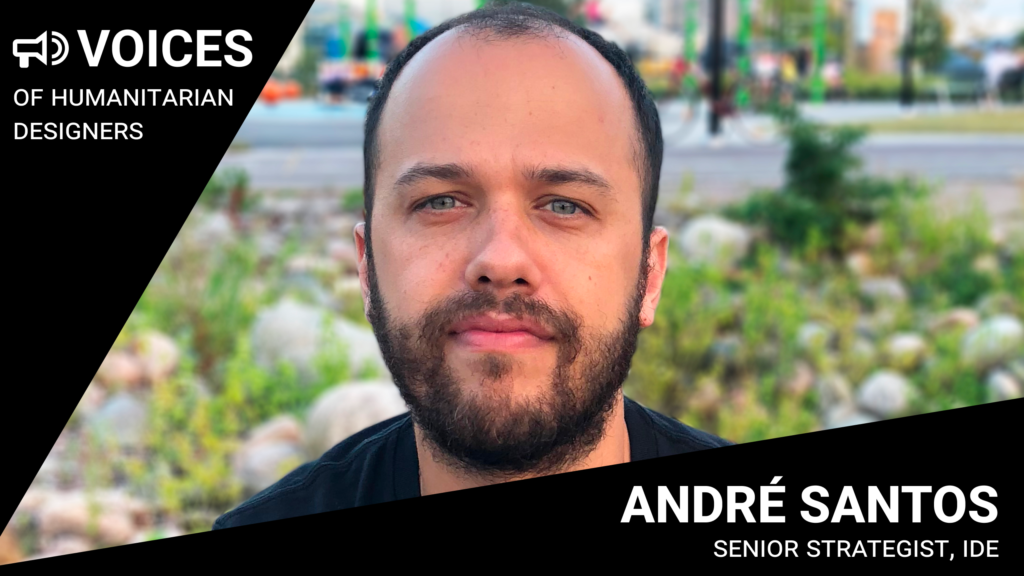
André Santos is a Design Strategist & Business Innovator | Systems thinking for impact at International Development Enterprise iDE
A designer that tackles complex challenges through a holistic approach, addressing people as part of an ecosystem rather than at the center of everything. He has come to understand that systemic and interdisciplinary thinking – as an integral strategy in the design process – contribute to the development of outcomes that bring sustainable value to people and organizations.
Can you tell us about a particular project you’ve worked on that illustrates what humanitarian design looks like in practice?
How has this project impacted your personal growth?
Were you able to build trust and make the design process work?
I’ve been working on projects that focus on strengthening local market systems so producers can get their goods to market more reliably. In practice, this isn’t about designing a physical product, but designing relationships and trust. It has really helped me grow because it forces me to slow down. You can’t really design a market system from a laptop…you have to spend time sitting with people and understanding why they’re hesitant to change. We built trust by not coming in as experts with all the answers, but as facilitators who were there to help them fix the gaps they already knew existed.
What types of challenges have you encountered in your practice? Do you have a quote, guidelines, something that frames or gives purpose to your work?
The biggest challenge is always the quick fix temptation. In development, everyone wants results yesterday, but systems take years to shift. So, you need to be patient and strategic…the worst part is to convince the client or donor that we need time to see results that can be transformative. A motto that always grounds me is “go to the people. live with them. Start with what they know. Build with what they have”. It reminds me that if a solution doesn’t belong to the community, it won’t last once the project ends.
Is there something you’ve learned from your experience that changed the way you approach humanitarian design today?
I used to think my job was to solve the problem. Now, I realize my job is to help the system solve the problem. I’ve learned we need to stop trying to be the hero of the story, as an organization. If we are the ones making the wheels turn, the whole thing will break the moment we leave. My approach now is much more about listening and nudging rather than building and commanding.
What would you tell someone new to humanitarian design about what really matters when doing this kind of work?
I’d tell them to listen 90% of the time and talk 10%. It’s so easy to get excited about a design or a strategy, but if you don’t understand the incentives, why people do what they do, the work won’t stick. Also, don’t be afraid of the boring stuff. Sometimes the most impactful thing you can do is fix a supply route or a data flow rather than something flashy, like a new, trendy technology or innovation.
Where do you find inspiration or perspective outside of your professional work? This could be something personal, creative, or simply grounding.
Outside work, I’m big on human connection. I love having long conversations with people who think totally differently than I do, that’s honestly where I learn the most. Lately, I’ve been trying to stay away from social media as much as possible and get back into reading. I’m also a big fan of hiking and trying out new sports to keep moving. My partner is an artist, which is a huge help; it forces me to use the other half of my brain and just contemplate things instead of always trying to fix or analyze them. It keeps me grounded.