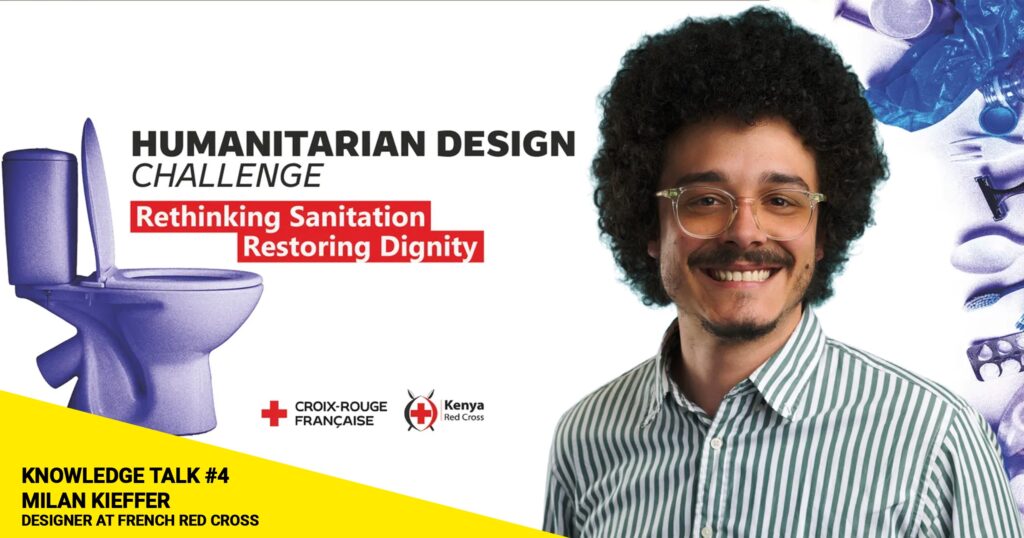
Milan Kieffer, design & innovation manager at French Red Cross – Knowledge Talk #4
- Knowledge Talks
Introduction
Milan Kieffer is a design and innovation manager working for the French Red Cross. He will present several projects that he has worked on with the French Red Cross, then talk about the humanitarian design challenge “rethinking sanitation, restoring dignity”, and finally, reply to some questions from the community members of Humanitarian Designers.
Resources
Transcript
Presentation
Medha: We will quickly begin. I just want to say I’m Medha. I am currently based out of New York City and I was in the first volunteer cohort of humanitarian designers. I’m currently on this specific segment of Knowledge Talks where we invite awesome people from all around the globe who are making real impact in the humanitarian and design fields. Today we happen to have Milan Kieffer with us. Please correct me if I did not pronounce your name right. We’re so glad to have him. He’s an innovation designer for the French Red Cross. I don’t know how to pronounce it in French but I will leave that to you, Milan. I will invite you now to introduce yourself. We are also looking forward to hearing about the Kenya challenge that’s also open until the end of this month. We hope to learn a lot from your journey as a designer. As a budding designer, I’m always excited to hear about others’ stories who are more established in the field. Please take it away. Thank you so much for joining us today.
Milan: Awesome. Thank you. Good morning, good afternoon maybe everyone. Thank you, Medha, for inviting me here today. I’m glad to share my work with other designers in the humanitarian field. It’s really a good moment for me. My name is Milan Kieffer. I’m a designer expert for the French Red Cross, Croix-Rouge française. You wanted the French pronunciation. It’s been two and a half years now, which is quite recent for this organisation to use design as a tool for innovation. I’m going to share a lot of different projects. Some are very small and close to, let’s say, graphism and informational design, while others are moving toward more organisational and structural innovation approaches.
The French Red Cross - Croix-Rouge française
Milan: Just a quick word about the organisation: we are a part of an international movement, the Red Cross and Red Crescent movement. It’s around 16 million volunteers worldwide, but in France, it’s 80,000 staff. We have employees and volunteers, and all together it’s 80,000 people. Our mission is mainly focused on the national level; it’s mainly the French population that we are addressing through the activity of the French Red Cross. A few of our activities are international but always in collaboration with another Red Cross. This is exactly the case with the Kenyan projects. We are working with the Kenyan Red Cross Society because it’s their field, their territory. This is how we approach international projects in the Red Cross movement. Our mission is mainly focused on emergency response, be it flooding or a pandemic, but it can also be daily life accidents. We also have a health sector, mainly hospitals and daycare facilities. The last part, the last pillar of the French Red Cross, is social inclusion. It’s all the activities around reducing precarity and poverty situations.
In that organisation, I’m part of the innovation department. Our way of doing innovation in the Red Cross is that we are a support to other HQ departments. We are here to give and to share innovative methodology for all other departments and topics. This is not like the Fab Lab or the research centre doing their stuff on their own; it’s always in support of another department. This is how we do most of our projects. We focus mainly on three different fields of operation. We are preparing for crises and how we manage crises in the French Red Cross. Another pillar is how to strengthen engagement, where we can make volunteers more willing to do more activities. The last one is driving digital transformation. We are a bit of an old organisation; the French Red Cross is 160 years old and we have the whole area of the French population. We need to make sure that everyone is on board regarding new uses and new tools, while also addressing digital exclusion amongst the French population. The way design is used in this innovation department is as a tool to bring a more human-centred approach. We are trying to bring that perspective, as design can do, to better express human problems and the variety of complex situations that can happen in complicated areas. So far the organisation was mostly using humanitarian standards to have that kind of barrier between what’s good and what’s not, but design brings that new way of thinking about problems with creative solutions. This is why I was recruited two years and a half ago to bring that new perspective into our work.
Our targets are not necessarily beneficiaries; we are mostly working for volunteers and for other HQ departments. Because volunteers and the other departments have the knowledge and they better understand the needs and problems, we are not necessarily experts towards the beneficiaries, but we are experts in the methodology of innovation. This is how we work. Regarding design specifically, I try to bring the approach that design is not just about aesthetics, it’s about impact. We work on three pillars, a bit inspired by the MIT D-Lab ladder of participation: design for, design with, and design by. I try to tag all the projects regarding these three levels. We make sure to move forward with a “design by” approach and not only designing “for”.
- In the “design for” categories, we are creating everyday solutions from operational tools to organisational change. This is the type of project where we identify a need or a problem in the field and try to work on that case mostly on our own, but still applying design methodology. We still get feedback from the users and improve the solutions, but this is not necessarily a project where it’s easy for other expertise to bring their inputs. It’s mainly design work.
- Then we have the “design with”, which is where we try to have a co-creation approach with volunteers and stakeholders.
- Regarding “design by”, we are not there yet. It’s a wish, but as it is quite new, we are not there yet.
- Finally, the fourth pillar is emergency design. It is also a new approach in our organisation. It concerns problems from international countries, national societies, and other Red Crosses. We bring that approach of frugal, robust, and context-adapted response for crises.
"Design for" projects
Rethinking the volunteering uniform by students from Strate design school
I have a few projects to share in all these pillars. For “Design for”, this is a very interesting project we have been doing with design students. We asked them to rethink volunteers’ uniforms. The goal was to add smart features like modular pockets, weather-resistant materials, and light-emitting components, but also to have flattering cuts for the variety of bodies our volunteers have. It also brings that sense of pride when you put on the jacket to make a real difference as a volunteer within the field. It’s crazy because small changes to the actual outfit can really have a big impact in terms of how you feel confident about doing your work. It has received quite a great interest from the volunteer community. Right now, the different pieces of different propositions have been merged into one design proposal that is currently being reviewed by the service provider for the next incoming outfit. That first project was a way for me to show that design is a creative process and that you can have very different propositions with the same brief. They were expecting only a few colour adjustments, but the students showed that you can completely rethink the way of defining this outfit. This has a great impact in-house.
The interactive booth
Another “design for” project we have been doing is an interactive booth that we tried to make to leave a long-lasting impression on participants. This was during ChangeNow in 2025. The idea was to raise awareness about climate change. I like the fact that the Red Cross is a first responder. When we talk about climate impacts, we are already acting to diminish the consequences of such events. It’s not just a foresight experience to think about climate change; it’s already happening around the world and the Red Cross is already there to protect the most vulnerable. During that salon, we developed this interactive experience where we use real-life testimonies and a service game so that visitors don’t just learn that there will be consequences, but they experience the challenge first-hand. That was a way of addressing a powerful message in a salon that was full of tech enthusiasts about climate. We took that place, and as you can see in the picture, we were quite unique in the salon. That was a way for me to show that design can also bring that impact in terms of experience. It’s not just making nice visuals or graphics, but it’s also a way of thinking of how people can interact with the space and with the people around it.
Infographics to support staff from the Red Cross
Another “design for” project is mainly informational, designed for information. The Red Cross is super complex and information can be overwhelming, especially since we are covering more than 120 activities. You can imagine that it covers a huge area of social trends, technological trends, health aspects, and so on. I’ve been using a lot of mapping to simplify complex data and to create a way for people to deep dive into different topics with the same level of understanding, whether you are a 16-year-old volunteer or a 60-year-old director of engagement. So I’ve created maps showing, on the left, a large trends analysis on volunteer engagement by 2030. You can see how different parts of the Red Cross understand how engagement is shifting in the future. I’ve been working with the foresight team to identify the engagement trends and then create a simplified visual for people to dive into this topic. On the right side, it’s a visual representation of the large array of crises that impact our organisation, from social to health issues to geopolitics, new technologies and so on. This tool today helps teams understand the different challenges and make informed decisions regarding their action and programme because they can say, “I didn’t see that trend; maybe it’s going to impact how I am talking with the beneficiaries in five years.” It really leads to interesting discussions in terms of strategic planning for the programme.
Another example of a simplified complex process: on the left, it’s the visualisation of how different actors respond during a crisis, their liabilities, and their actions. By breaking down this scheme, we make it easier for teams to coordinate and act efficiently. It’s also a good tool for training newcomers who are not familiar with crisis management. It is a big mapping of what they are doing and who is who. On the right, Cedric, you might be interested in this: it’s a visual mapping of interaction between institutional actors of the humanitarian sector. It helps us understand the implication of international politics regarding humanitarian action and programmes. It’s used to identify funds and how we can improve our network amongst this ecosystem. There is quite a lot of mapping, but I think it’s a powerful tool as a designer to bring into this type of organisation where information is plethoric and mainly accessible to people who have been there for 20 or 30 years and know everything in their head, but nothing is on paper. I like making these tools for different departments just to have a big piece of information that we can share all together.
"Design with" projects
Then we have a few projects that I call “design with”, using a co-creation approach. I try to bring volunteers and stakeholders more into this type of project because their expertise is more needed. A good example is this interactive exhibition that I’ve done with the ESR departments. It’s an interactive exhibition on climate change where you are put in the shoes of a French climate migrant in 2050. You have to go through different years and each year you have to make choices. You have dilemmas and you try to survive this apocalyptic world. Today it has been used by different volunteers all around France to raise awareness about climate and to bring people a bit further from the Red Cross perspective. Many French people don’t necessarily associate the Red Cross with climate action. This tool helps the population to bridge that gap between our action and the consequences of climate change. For this exhibition, I tried to apply a very low-tech design approach. We could have made a digital experience or a video game to achieve the same effect, but I wanted something simple that anyone can print and assemble in their own facility. This is why we chose to make this paper project for the ESR department. I see in the chat, I will share the mapping afterwards.
Deck card “What if the Unexpected Happened”
Another “design with” project is this game that we call “What if the Unexpected Happened?”. It’s a game to help people prepare for systemic crises. It’s a collection of 52 cards where each card represents a crisis that is a bit surprising or disruptive. The goal is to make yourself comfortable with uncertainty. You don’t necessarily have an answer for all the crisis situations, because it is impossible to anticipate everything, but rather you develop cognitive habits regarding those “what the fuck” moments. We’ve done this exercise with the foresight team, who bring trends and that future forward-looking perspective. I try to make this very simple for everyone to understand the rules, how it works, and all the mechanics behind it. It’s a game that is quite widely shared among the volunteers. We are doing the third edition, so there are new cards added to the pile. We have seen some volunteers sharing crisis cards even if they didn’t necessarily receive the last version. We have a stronger engagement with this game. I think it’s because of that design approach that makes it very simple to understand and use when you get 20 minutes or one hour of waiting under your tent.
Immersive training exercises with emergency and operation teams
I’ve been working also with the emergency and operation teams, mainly on designing immersive exercises to train teams for crises like cyberattacks or natural disasters. I try to bring design to simulate real-world scenarios using immersive content such as radio, video, prints, and anything to make that immersion real. In that way, volunteers and staff can practise their response in a safe environment that is not totally real but requires less effort than a real-life exercise. This really helps to build confidence and readiness for a lot of newcomers who might be afraid of crisis management. By doing this type of game, they can understand the different processes, what matters really in crisis situations, and what the different actions are that they can take. It’s training and also a good way to exercise for experts. I’ve been doing this a lot. It’s quite fun to do. The one on the left is a blackout; we try to turn off all the lights and put everyone in a pitch-black room to simulate the total blackout of communication and electricity. It’s improved workshops.
Facilitation of strategic workshops
In terms of workshops, I also design and facilitate strategic workshops. Here the example is that I helped the board of directors to plan the association roadmap for the next five years. It was a way for me to show that design is not just for products but is also a powerful tool for shaping the organisation. As a designer, I know that we have better ideas when we have better paper to draw on. I try to bring very qualitative material to these kind of workshops to make participants feel that they are doing something that matters. It usually works. If you are in that case, I invite you to spend some time refining your workshop materials.
Joining emergency operations
Something I wanted to share, since we are a humanitarian and social organisation, I also take part in emergency operations, either on the field or in HQs. It’s something that’s super important for me to do because this is how you really understand the problematics and the fields. I try to be involved in most of the operations that we take care of.
Collaboration with ENSCI Les Ateliers
Moving on to emergency design and to give you a bit of context around the challenge and a bit of history: since design is a new approach for the Red Cross, I had to find a way to demonstrate the power of design in humanitarian fields. I initiated a six-month programme with ENSCI, which is a French design school. It’s very famous and quite prestigious. We asked the students to develop practical solutions for humanitarian challenges. It was amazing; their propositions were really incredible. They brought very fresh perspectives and innovative ideas to the table. There were three projects that I’m showing here that really ticked in my colleagues’ brains. They wanted to make prototypes and to find a way to bring these projects into the real world to benefit communities that are in need. This is where I understood that my colleagues really understand the impact that design can have on humanitarian operations. We moved from a student project to a real-life product. Based on one of the students’ ideas, we developed this 3D-printable tap solution with the Kenyan Red Cross. On the left, this is the student one. In the middle, it’s the first prototype conceived with the Kenyan Red Cross. On the right, this is the last version that I will be testing in July. The idea of the project is to bring a tap solution to areas where they don’t necessarily have these resources. Sometimes they just use a bucket for water and a cup to scoop the water. A tap is really a nice addition to their life. It’s simple and adaptable to many different types of containers. Having this first opportunity to work with the Kenyan Red Cross, which has a Fab Lab in Mombasa, we decided to create this kind of stream process of innovation. We decided to join our forces with the Kenyan Red Cross to work furthermore on innovative products.
The humanitarian design challenge on sanitation
Milan: This is what led us to create the humanitarian design challenge to make this type of project at least once a year and to just go with the flow, test, and learn directly on the field using the French Red Cross design expertise and the Kenyan Red Cross production skills. Moving on to the humanitarian design challenge, I know that you had already a few moments to talk about this, Medha and Cedric. Do you want me to go through the general presentation or do you want to just do an exchange?
Medha: I think in the interest of time, because we’d also like to open this up for questions and answers with you, based on everything you’ve presented so far, it would be great if you can also take us through the design challenge, but maybe just a little quickly. In terms of deadline, eligibility, what’s required, what the actual challenge is, and what you’re looking for.
Milan: Regarding the situation in Kenya and the camps in general: in many refugee camps, sanitation facilities are able to respond quickly but not sustainably. This is quite expensive and not very durable. Moreover, most of the latrines that have been used in Kakuma, the refugee camp where the project takes place, were funded by USAID. Right now, there is no more money at all for this part. This is why we launched that challenge to find a solution for that problem. Today Kakuma is home to 300,000 people, and we are experiencing high pressure on infrastructure. When you know that when sanitation fails, it directly affects health, safety, and dignity of people, especially for women and children.
This challenge exists because sanitation is not only a technical problem, it’s not only about finding a cheap, affordable solution for sanitation, but it’s a social and human issue. In terms of impact for this challenge, the goal is not just to design a better toilet. As I was saying, we are expecting a triple impact: improve dignity and daily experience for the whole user, reduce environmental impact in waste, because right now the situation is quite dramatic, and to stress local innovation capacity by providing an open and reliable solution directly on the field. One idea of the project is to bring production and machines into Kakuma so they can build their solution at the end. We’re looking for solutions that are useful in that way and that are respectful.
Regarding the infrastructure, an important clarification is that you are not designing the pit-latrine system itself. We are not looking at the toilet bowl where the waste goes, but we are looking at the structure. We mean the walls around it, how it can protect privacy, how it can protect against intruders, how you feel inside, and how it can be easily built, repaired, and reused. We are mainly looking at the user experience of the latrines and not just the construction. In terms of social aspects, as I said, there are 300,000 people from more than 20 nationalities and hundreds of cultural backgrounds. A latrine can be very different from one household to the other. The problem is that a single latrine can often be shared by many households. We have seen different conflicts around latrines because of that. Cultural norms around privacy, gender, and hygiene deeply influence how sanitation is being used. It’s interesting to see how designers can deal with these aspects of cultural understanding. This has been covered by humanitarians before, but not necessarily in the way designers look at these kinds of problems.
In terms of humanitarian vocabulary, it’s a WASH project: water, sanitation, and hygiene. Behind sanitation, we talk about health and dignity. The solution must be easy to clean and easy to repair. We are looking for something that is robust and strong in terms of structure. If you look at the video, one of the guys said that sometimes when it rains, the floor collapses and they have found kids drowned in the waste. This is a really concerning issue. Other than that, another guy is talking about a cholera epidemic in his neighbourhood. We can understand that sanitation is a really important problem to tackle. They have been experiencing long waiting times. As I say, when one latrine is shared by sometimes six to eight households, more than 20 people, you can imagine if you have only one toilet for 20 people during a year, it can create problems.
Regarding poor lighting, most of them don’t have electricity directly in the latrine. They are either going there during daylight, or sometimes they can bring a torch, but they might just go there in full dark mode at night. Regarding safety, there are broken doors and no locks, so it is very unsafe.
There is a lot of insecurity around latrines. We know that most of the violence towards women and children happens either in the household or in the sanitation facilities. We realised also that when there is a light and the space is lit, it reduces violence by 60% to 70%. It’s interesting for us if you can bring that into your thinking.
In terms of materials, I talked about reducing the environmental aspect of the latrines. One aspect of this challenge is the circular design approach. In terms of valuable waste that Kakuma produces in large amounts, we find plastic bottles, a lot of packaging, textiles, and a bit of wood. Also, if you look at the index on the website in the annex, you have a mention about bones. There are many animal bones available in the camp. Those materials can be a good way to address the challenge and how we can make a solution from them. If we look at the different machines that we can use for local production, I invite you to go to the iome website and look at the machines they have. Maybe it can give you ideas on what to use for production.
If you have questions around humanitarian standards, the main reference is the Sphere standards. You can have a look at those; it clearly defines what is a safe sanitation place and what is considered accessible and private. Take a look at this document; it’s very valuable. It has a lot of constraints, but the designer’s work is to work with constraints. They are not limits; they are part of the design brief.
Regarding the criteria, this is how we will be evaluating the project with the jury:
- The first one is humanitarian relevance: does this project really improve daily life in a camp in terms of dignity, privacy, and safety?
- The second one is creativity and originality: think low-tech. We are not a private company with millions of pounds in cash. Simple, clever, frugal ideas are often more adequate to our reality.
- Then we have sustainability and circular thinking: how do you reuse materials and reduce waste?
- Feasibility and costs: something that can be built locally with local tools, local skills, and limited resources.
- User experience: we will have a look at the accessibility and comfort, and whether it is culturally proper for the different population of Kakuma.
- Last but not least is adaptability. It’s great if the solution can evolve and be reused in another context. Also, one way of looking at it is: can we build on your solution to add a tap or combine two latrines together? Think about the modularity of the solution you propose.
Probably you won’t be able to cover all different aspects, but this is where you can have that design orientation. This is a complex project. You don’t necessarily have access to a lot of inputs from the field. We are not looking for perfect projects; we are looking for relevant and realistic design proposals.
The main work will happen after the selection phase where you will be able to go to Kenya for a week or two and work with the local communities and the Kenyan Red Cross to refine the solution and make a few prototypes. We’re looking for ideas, not necessarily the perfect idealistic solution. It’s open to anyone. There is no prize pool or cash prize. We are expecting many students to answer the call, but it’s open to any designers, engineers, innovators, or makers who want to address a humanitarian challenge. The deadline is the 28th of February. It’s quite short, I know. I have a few calls with students this morning and they are starting just right now, so it is still doable. Feel free to join and ask any questions on this challenge.
Q&A
Medha: Thank you, Milan. Thank you so much for this amazing presentation. I really appreciate it. I’m not on video right now because of my spotty internet, but I hope you can hear the enthusiasm in my voice as I say that this was a very refreshing presentation. It reminds me again of why I like the designers’ field so much because even in these extremely complex and serious situations and crises around the world, design is able to bring a playful and fun perspective to bringing solutions to these current wicked problems. I really appreciate your perspective and all of the projects that you’ve shared, from designing experiences in the physical world to designing games. I now welcome anyone to ask any questions that you might have and a request to Milan to please share your presentation if you’re open and the institutional ecosystem visualisation if you can share that as well later after this call. Thank you Beatrice for joining. It’s okay that you had to leave. Take care. The question and Q&A session is open to all. Please feel free to ask any questions of Milan.
Question: I have a question that’s not about the challenge so I’m not sure if it’s a good time for that, but for the previous presentation. I’m curious: who owns the problems? For example, it’s obvious when you have an event and you design the Stanford event. For the 3D-printed water tap, where does that come from? Is it something that the Kenyan Red Cross has a problem with and comes to you, or is it coming from you? What is the origin of those ideas?
Milan: Good question. I think we are learning by doing here. For the ENSCI student projects, they make their own design methodology; they were trying to get in touch with refugees using TikToks and Snapchat. They have been very creative to find ways to connect with populations that are actually impacted. The first project that we have been working on with the Kenyan Red Cross was a bit of an idea out of the blue. It wasn’t a problem that was initiated by locals, but when we shared the idea with the Kenyan Red Cross Society staff, they defined it as interesting enough to make a prototype and to carry on with this design. That was the first opportunity for us to work with them and we decided to change this approach of a French design student having ideas for the field. The latrines problem is a problem identified by Kenyan Red Cross volunteers in Kakuma Camp. They have seen that the funding from USAID was done and that people were still coming into the camps while the latrine infrastructures were still insufficient. They brought that input to the table and we decided to create the challenge like that. If I can take a minute more and elaborate on that, because I am curious: in general your work involves a lot of stakeholders who want things from you, and you’re putting out fires or pursuing projects. I’m trying to figure out how your work is structured. As I said, there are the four levels of the design ladder and currently we are not in a moment where I’m doing capacity-building design amongst the beneficiaries or even the volunteers of the Red Cross. It’s mostly either the innovation team that identifies problems we can address quickly. This was the first few projects that I shared: mapping. This is just me saying, “the information is not available, I will make a map,” and I do the map and everyone is happy with this. This is why I say “design for”; this is my designer mindset that identifies something that I can solve with design tools. The other way is the “design with”, where I have other HQ departments that come to me and say, “I don’t know how to do this and maybe you can help me on that project,” and we work together on a solution. The ideal goal is for me to have that capacity-building design methodology in the volunteers at least, so they can use design daily in their own life and not necessarily rely on my personal skills to make a project. Thank you.
Medha: Thank you, Milan. I have a question too, but if anyone else has a question you can also go ahead. Cool, I’ll ask my question then. I think something cool that humanitarian designers are addressing is the gap between the humanitarian and design fields and trying to bridge that gap. One of the ways we do it is through education and awareness. I think you are also doing that; when you design experiences in the physical world you are doing it through education and awareness as well. I want to understand—because at the French Red Cross this is still very new to have design there and an innovation team—how are you addressing the gap between the humanitarian and design fields, and how can we maybe learn from your learnings?
Milan: What I understand from my two-and-a-half-years perspective is that operational teams need proof and they need concrete projects. I try to do fewer PowerPoint presentations and more mock-ups, visuals, and prints; stuff that they can hold, test, and interact with. If we are talking about strategic programmes, here is a map that I drew with my pen on a paperboard and we highlight what we are doing. That way they understand that thinking about problems is not necessarily about having a very analytic and exhaustive analysis, but sometimes it’s a matter of just doing stuff and working from there. The more I can make stuff visual and concrete that we can break and mash up, the better it works. I think the main input of design in this organisation is that we have the same mindset. Humanitarian and designer, we have that human-centred approach that is meant to be connected, but we address problems in different ways. Design can bring that level of concrete stuff and then creativity just flows like that.
Medha: No, it’s super clear. I think us designers, even before we step outside the world, we need to convince our own organisations how design works. In terms of educating our own teams, it sounds like a very feasible option to have visualisations. I think that works way better than PPTs. Something that we learned at design school at Parsons was where one of our teachers said, “I don’t want to see popcorn presentations for your midterms; show me something else. I want to see films or audio or an enactment; do theatre, do something different.” It’s great that you’re opting for visualisation and something more graphic; it’s easier to grasp for sure. Over to you Cedric, I think you have a question.
Milan: Another important aspect is that you can always say that it’s a “work in progress”, so it opens the perspectives. Making something when you are not used to a design mindset always feels like “this is the best stuff I can make,” whereas I try to bring a huge array of solutions so people understand that we can do this mapping that way, but we can also not make a mapping and make a video, for example.
Question: Thank you for the presentation, it’s funny because I see a lot of similarities with my own journey in this field, such as the 3W map. I would have one thought, one invitation, and one question. The thought that I liked is your mention of the “design for, design with, and design by” which is an interesting way to cluster projects; I also liked that you said “we are just expert in methodologies”. I think these could help Humanitarian Designers in our positioning as an organisation as well. Then, I discovered your project with Strate design school and I would like to invite you in collaborating for listing and sharing these students projects. We have done a similar project in the past of sharing students’ thesis and I often wanted to reiterate this initiative. Finally, the question, is that I heard you saying “evidence-informed” and “foresight” which triggers me a little bit because I also use these words at work, so I am wondering: what is the place of science in your work? And do you have an organisational chart of the French Red Cross to see where designers could fit in?
Milan: The way I approach most of the projects, I say that I’m just an expert in methodology and creativity and thinking about problems differently. I try not to bring the science aspect or the expertness of any subjects. I bring the space where people who are experts and where the scientific approach can express their knowledge in a creative area. For example, for the game “What if the Unexpected Happened”, I worked with the foresight team. They are experts in foresight and in trend analysis, and they are connected with a huge array of experts in sociology, in geopolitics, and so on. They are taking inputs from this group of experts and then writing 120 pages of foresight trends. This is where I interfere and try to make that clear and simple for anyone. Science is made by others and I just find ways to make it simple for anyone in my organisation. It’s super important because it’s easier for people from a board of directors to speak about foresight, but when we are talking to a volunteer who is a 16-year-old woman, she is not there to talk about foresight. She is there to take action and to be on the field and to meet people. Finding the way of making her have an interest in this field is the design work. Foresight is not new for the Red Cross. It is in the statutes of the organisation that we should have a committee of foresight orientation made by external and internal experts. It has been in the statutes for more than 10 years. They gather together four times a year and they highlight a specific subject for the organisation, mostly for the board of directors. This dynamic of foresight in the Red Cross has been quite well understood and applied to strategic projects, but it was always at the top level, for the decision-makers and not for the volunteers. This is why they recruited a designer at the start. They were looking for someone to bring this prospective foresight material into the field. This is how we connected with the Red Cross.
Medha: Okay, cool. In the interest of time since we are 17 minutes over our actual time and want to respect everyone’s lovely evenings. It’s still a really lovely snow day out here in upstate New York. I guess you all want to go and relax now in your evenings in Europe. This is going to be a great conversation where I tell you what’s happening with the French Red Cross and how design is contributing to it. I’m always looking for new ways to explain design to my parents and friends who are not in design. This is really lovely content. You’re awesome, Milan; I wish we had more time to chat. I hope you all join; you’re all awesome too. Thank you so much for joining today. Milan, we hope to have you over again and discuss more of your projects and details. This cross-collaboration between organisations is also great; we learn from each other. Please do share your presentation; we look forward to that. We’ll see you all again in March for another session. Take care. Bye-bye.