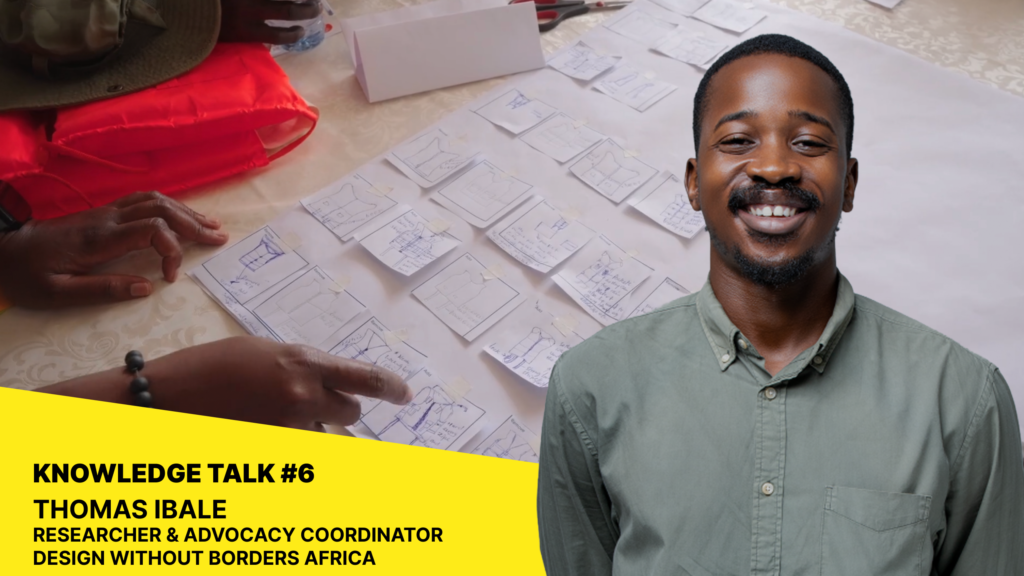
Thomas Ibale, Researcher & Advocacy Coordinator at Design Without Borders Africa – HD Knowledge Talk #6
- Knowledge Talks
Introduction
Thomas Ibale is a researcher and Advocacy Coordinator at Design Without Borders Africa, based in Kampala, Uganda.
He will share how human-centred design can be used as a participatory approach to solving problems with communities, not just for them.
Drawing on his work in social innovation and development across East Africa, he’ll explore what it looks like to embed design practice within community-led processes.
Resources
Transcript
Intro to Thomas' journey
Misha: Thank you everyone who joined. Today we have Thomas. Thomas works for Design Without Borders Africa and will be speaking about one project in particular, if I’m correct. This session is a little bit ad hoc, so we don’t have as many people, which means that we’ll have probably more time for questions than usual. I think we can start. Welcome, and thank you for joining.
Thomas: Thank you. Thank you guys so much for having me. As Misha said, my name is Thomas Ivali. I’m from a small tribe in eastern Uganda called the Banyeole tribe, and I’m happy to be here. Without further ado, let’s get started. Today’s sharing, I’m going to give you a couple of introductions about myself and my background, as well as the current project we’re working on, a few process photos, and also takeaways and next steps and things that I’ve learned from this journey.
Who is Thomas? Who is this person before you? I can describe myself as a student of the game, the game of life, just trying to get better every day, trying to improve myself in any way I can. If I’m better for myself, then I’m better for the people around me, and that translates to being humanitarian: caring about people, trying to improve their lives, trying to save people, and if I’m better, if my neighbour is better, then everything will work, just working in community.
I’m a researcher and designer with Design Without Borders. My background is mainly in development studies and philosophy, and I transitioned to design, which I’ll explain in the coming slides. I’m also a farmer. I’ve tried poultry keeping, and right now I’m venturing into beekeeping. I’ve always been scared of bees, but I’m hopeful that this will be a good venture, and bees can survive on their own as long as I’m a bit far from them, and maybe I’ll overcome that phobia. I am also into martial arts, I do Brazilian jiu-jitsu, and soon to be a disc jockey; I have a big passion for music. My favourite artist is Bob Marley, and hopefully, I can venture into that this year. I try to keep myself busy, and that’s basically Thomas in a nutshell.
My journey started when I graduated undergraduate at Strathmore University in Kenya with a Bachelor in Arts in Development Studies and Philosophy. Once I was done, I volunteered at the Ministry of Gender, Labour and Social Development, so I worked a bit with the government and saw how things work, and it inspired me on my journey. At the same time, I was also a learning facilitator at Social Innovation Academy, and that’s actually where I came across design, in particular design thinking. At the Social Innovation Academy, we work with refugees to create social enterprises that solve problems in the community, and so that’s where I saw that connection between design thinking and innovation. Eventually, I got the opportunity to work at Design Without Borders as an intern in 2023, and since then I was taken on full-time, and now that’s where I have become Research Advocacy Coordinator.
The Enhancing Fisher Folk Safety Project
Thomas: Into the project that we’re currently working on, the name of the project is the Enhancing Fisher Folk Safety Project, and this is to do with protecting fishermen from the problem of drowning. Drowning has become a very big epidemic, not just in Uganda but in different countries in Africa. Due to the access and use of water bodies, both for fishermen and transporters, there are always incidents that happen. The goal of the project is to develop affordable and contextually relevant flotation devices, which can be a life jacket or a life ring, or it could take any form, like a group flotation device that everyone can use in case of an emergency. One of the other goals is to improve communication and comprehension of weather information amongst fishermen. How the weather information gets from the Department of Meteorology, which is the body in charge of disseminating weather information, to the fisherman, and how effectively can that work? Can it be through a certain medium? Can it come at certain times? Once these two goals are tackled, then it will also lead to positively influencing the behaviour of fishermen to adopt safety measures. Right now, the fishermen might not trust the weather information they receive, or they might be less inclined to buy a life jacket because it costs a lot of money, and hopefully, at the end of this project, we would have positively influenced their behaviour and make them adopt better safety habits and take those measures even before they go out into the lake. Also, to return back to the water when they understand the gravity and magnitude of what it means to lose a life, and also it could affect the rest of the community, especially the immediate family and the boat owner, and so on.
For this project, we’re working in these districts. What you have here is the map of Uganda, and this is Lake Kyoga right here in the middle with the districts marked A and B: A is Soroti and B is Serere. Then on Lake Victoria, which is down here, we have districts marked C, C is Mayuge, and when you go further down south you have D which is Masaka, E is Kyotera, and F is Rakai. These are the districts that were identified by the Makerere School of Public Health as having very high cases of drowning. Starting from Uganda, it was reported between the years 2016 to 2018 by the Makerere School of Public Health that 2,066 cases of drowning had happened in those years. Also on a global scale, in 2023, the World Health Organization reported an estimated 236,000 annual deaths worldwide. These are very staggering numbers, and the numbers are only increasing if the fisherfolk do not take safety first, and we are here to help them with that. We’re here to design systems and also products that could help bring this number down and resultantly hopefully everyone is safe to use the water. Out of these incidents, 95% of those involved were not wearing life jackets, and 58% were attributed to bad weather conditions. Due to different factors like the life jackets being expensive, or sometimes you have to travel very far from the landing sites because, if you go to the map, you’d see Kampala is around here, and now if you’re trying to get a quality life jacket, most of them are in the capital city, so it’s harder for them to travel to the main towns to get the life jackets, which could be a problem of access and also a problem of cost. We are currently tackling those issues. In the slides that are coming up, I’ll explain that further.
Methodology: Human-Centred Design
Thomas: What we’re doing right now is using human-centred design to save lives. In my own words, because there are many definitions for human-centred design, but I hope this one does it justice: human-centred design is a creative approach to problem solving that starts with the end user and ends with a tailor-made solution to fit their need. Everything surrounds the end user; they inform the whole process. By the time you develop a solution, it has to fit them, it’s true to their context, and it’s organic, it’s something that they can relate to and something that they can be able to replicate by themselves or as they go forward, pointing towards sustainability. This involves understanding the fishers’ needs and circumstances, as well as constant dialogue and refinement with fisherfolk. Even from the start of the project, when we did the research, it’s still going on, it’s constant dialogue, it’s constant learning and trying to understand what exactly the pain points are, and the strengths as well if they are there to leverage for the fisherfolk.
Just some more insight into the process that we use, here we have what we call the double diamonds, because when you look at the shape, it’s like two diamonds. Right now, we are at the develop stage. To get there, you go through discover, define, develop, and then eventually we’ll deliver next year. Hopefully, by this time next year, we could even show some of the work that’s been done, but the pilot starts at the end of this year. I’ll go through the discover, define, and develop phases in the next slides.
Discover is just trying to understand the people, the needs, and context, so practicing empathy, stepping into their shoes, and understanding what exactly the problem is, which could change because you could come with your own bias, you could come with your own thoughts, and when you realise that, oh, okay, this is what they’re telling us, the problem could change, it could get further defined. Once that’s done, you go to define exactly what it is. You interpret the findings, you gather all the data. We would sit down for long hours as the team, we try and see about what’s important, what are the main key points, so continuous discussions internally as well as still with the community, because whatever we gather, we have to confirm with the community; they are the decision maker in that process. Once that’s done, you go to the develop phase, so the potential solutions, you generate ideas, prototypes to tackle the challenges defined. Here is where you go wild with everything, and if you notice, as the diamond gets wider from discover and narrow on defining, it also goes wider on develop. You just have to go crazy with the ideas. We have to make sure features are able to generate as many, so we have a big sort of idea bank, and we can always refer to it because the ideas could change or they could complement each other. We always have to have the ideas stored as we proceed to concept development and testing. Once we’ve tested the solutions, we run the pilot and refine the solutions. We do test cycles right now, in the first cycle which we came back from about two weeks ago, so we’re testing some of the solutions and hopefully we can get to refine them even further. We have a trip coming up in June back to the communities, and once that’s done we can run the pilot and get involved with the… we’ve been in constant dialogue with the necessary bodies, so if it’s for flotation devices, we’re talking to the Uganda National Bureau of Standards and things like that, having those constant meetings and dialogues; if it’s the Department of Meteorology, we’re having those constant meetings week in week out as we continue to refine these solutions and make sure they hit the right spots. So that’s the double diamond, the four Ds: discover, define, develop, and deliver.
Discovery: Immersion and Data Gathering
Thomas: The discovery phase, we’ll get into now the different processes of the project. The discover phase in some cases can be described as the inspiration phase. It involves immersing yourself in the context of the people you are designing for, practicing empathy, stepping into the end user’s shoes to see things through their lens, and there you get a better perspective on the problem you’re trying to solve. Notably, we always have to ask for consent. We don’t just storm in; it’s not right to just walk into a room and start taking pictures and taking data. You follow the principles of research ethics and maintain confidentiality, and we go into the field, move above bias, so just free, open to anything, open to finding whatever, and once you have an open mind, then the sky’s the limit, you can get as much information as possible.
Here are some process photos from the discover phase. Here we have focus group discussions with fisherfolk. The fisherfolk include fish mongers, community elders, community leaders. In this picture you can see one of the research assistants, Steph, was invited into the house of the fisher. We had this whole family and a few more people there. You have discussions, you try to ask questions, you try to probe not just around drowning but then you probe around different topics like what’s the living standards, level of income, and the socio-economic factors as well. Here on the right side you have a picture where we’re talking to community leaders. You speak to the community leaders, and some of them also have… we have the marine police, so they’ll tell you some of the incidents that have happened, they give you a history of things, they’ll tell you what has worked and what has not worked. Gathering as much data from all these different stakeholders gives you a diverse, multi-dimensional perspective on things since you have everyone’s input on the problem.
Also in the discover phase, here we have me over there gathering data on the months with the most turbulent weather conditions. Remember we’re trying to improve weather formation systems. We try and document the different seasons, and right now it’s a bit tricky because, with the climate change issue, the seasons start to change, and the fishers also express that; they say, “oh it used to rain a lot in December but now it has stopped, it used to be very hot in January but now it’s raining.” Trying to get those different findings and trying to understand the calendar and weather system. Here we have a dialogue with a fish trader. Speaking to people who are within the stakeholder sphere of the fisher, he might not be the fisher himself, but the fish trader has information which is also very valuable. He’s the one who receives the fish when the fishers return to the shore. He can tell you the different times which they go out to fish, the different types of fish they catch, and all this is valuable information because you now start to see the patterns. You see that with the night fishing, the people go late at night, they’re going to fish a certain… it’s called a silverfish, very tiny fish called mukene, and also there’s the risk of going to fish at night because there is low surveillance on the water by marine police and things like that. It starts to uncover even more information that’s valuable when you’re now trying to see how to deliver the weather information at the different times of the day, so that a fisher can be informed even while they’re out in the water that, oh, tonight it might rain, so I need to go with a life jacket, or I need to be going in a group with my friends, because there’s also that communal sort of bond and they move together in groups. If they take those safety measures as well, it would help them.
Here also you have a roleplay activity. We use roleplay to bring out some of the information we need. We would ask the fishers to draw a boat on the floor, you can see the chalk over here, some of the equipment they use, just to improvise, use some cups. That’s the scooper that they use to lift the water that enters the boat or to store fish sometimes. They use a jerrycan as a backup flotation device for people who can’t afford a life jacket. This has also been identified as a design opportunity, that we can be able to design flotation devices that incorporate jerrycans. Since these are always readily available in the community, this was valuable information for us to know. The fishers will also sit in a certain order that will see okay there’s maybe two fishers who sit, there’s a coax man, and then maybe a pilot, and we start to see the formation and how they go out to fish.
Then it would also involve interrogating the current flotation devices in the market. Here you have one of the community elders was telling us about the life ring and why it’s important, why he prefers it to the life jacket for example, and then also the different fishers in the room would listen and chime in, give more information that would help us gather as much data as possible.
Then we had a couple of interviews with the tailors in the community. The tailors are a very key point for us because once we’ve been able to develop the flotation devices, they have to be able to be made by the tailor, so right now we are providing materials to the tailors to be able to make some of the designs that are coming up with. Right now they’re not ready to show, but hopefully in the coming months I’ll be able to share in the community chat and with the rest of the team, but we have to speak to the tailors and they’ll give us the experiences they’ve had. If it’s to deal with fixing flotation devices, we’ll get some valuable information on that. This specific tailor here was able to make a flotation device by her own, like someone would come and request and say, “oh I need this flotation device made.” She would tell us as well how much it would cost, what would be involved, and the length of time, if it takes three days, if it takes four days. She was able to make one out of jerrycans, which was pretty impressive because you now start to see the positive deviance, the people in the community who are already coming up with solutions to the problem of drowning. That’s also very inspiring to see in this space.
Then here’s a picture of a low-quality life jacket in the market. You can see the standard already, this is not something someone would trust even when they look at it or want to wear, but it’s what’s available and it costs about 20,000 Uganda shillings. If I’m to do the math, that’s about four, five dollars. It’s the cheaper coasting flotation device, but it’s not the most reliable. Funny but sad enough, there were some quotes from the fishers that were saying, “ah this is a flotation device that you wear if you just want to be identified on the water when you’re drowned.” There’s not so much humane that it’s because people would laugh, but it’s a very serious issue that this is what’s readily available and it’s not up to standard. It’s our job to come in and fix this.
Defining the Challenge: Journey and Stakeholder Mapping
Thomas: From all that information we’re gathering we’re able to come up with the journey map. The journey map informs what the fisher does, his daily activities, and at the different timestamps. While we’re collecting the information we had the information gathered and also while we’re doing the collection of data there was one of our designers Nora, she’s very talented, she was able to sketch some of these things and we further refined them with another one of our communication designers Elsie. I have to pick them up because they’re a great team, they’re very good at the visuals. She did the visuals for the journey map and you see the different timestamps from when it’s 5 a.m. to 8 a.m. the fisher sets off to go out into the water. They usually take about two hours to reach the fishing grounds and preparation, setting up the nets, is also a process and here you have the different hazards that are highlighted in the orange boxes. There are certain things that also are not within our scope but happen in the journey: if a fisher goes out to fish and then there’s floating islands, so their boat can get trapped. Here you also have something that we noted was that some of these flotation devices have hooks and now the net can hook onto the jacket and pull you into the water. That’s also a hazard and something we have to consider when making the designs. Some of the fishers go out when they are intoxicated and they run the risk of falling in the water. Sometimes they don’t have the life jacket on them and when they fall into the water then it’s a problem. As the day goes on, let’s say the fisher has gone on the journey safely has reached up to this point, there’s also the threat of the weather changing; heavy winds and heavy rains they told us could damage the boat or overturn the boat and those sudden weather changes they can’t really prepare for because also while they’re out in the water it’s hard for them to receive the weather information. We are also exploring having sort of like beacons that light up maybe in the distance or finding a way to connect to satellite which is also a bit not in our forte, so we now have to partner but we are also just exploring certain things where it’s okay if the fisher is out on the water how can we get this information to them? Once the fishers are back they sometimes cook while they’re out on the boat or they carry the food and then once they get back around 2–4 p.m. they hand over the fish and then there’s also the threat of the leaking boats. There’s also people who go out and fish on illegal boats and now that also brings up tensions between the marine police because marine police go out looking to clamp down these people and they are also trying to escape and basically also trying to make a living, so there’s that tension between the marines which you also have to navigate correctly or safely. Then there’s certain things like engine failures that may cause damage to the boat and that’s also another problem still. All these different activities happen within maybe a typical day or at different points in different scenarios of a fisherman’s journey. Once they’re back they always return a lot of the times they either have boat owner who now they hand over the fish to. You’ll also see that there’s an ownership of boats where the fisherman is not the person who owns the boat but the boat owner invests in the fisherman to go out and fish. There are also those dynamics and that’s an important dynamic.
In this stakeholder map, what we have here is the different people that influence the fisherman at different levels. Here we have the immediate sphere: the stakeholders like the boat owner who I’ve just spoken about and then also the family because this is usually the last people or first people the fisherman sees before he heads out and also when he comes he always reports to his family. Also part of the process of a fisherman is to leave money at home or buy food and make sure everyone is fed before they go out into the water because in some cases fishermen would go out for two or three days, so they spend quite a lot of time out on the water. Then outside of this sphere you have the health worker who’s always at the landing site and they’re always health centres centred either at the landing site or some distance from the landing site. You have the community announcer, the people who move sharing information whether it’s about topics like immunisation or if there are campaigns happening. You have the community tailor, you have the local leader, you have the fish trader, you have the processor, the person who sells fishing gear; so if it’s fishing hooks, nets, life jackets they’re also in this circle, a boat builder and so on. Then outside circle you have the marine police, the fisheries officer who’s not also very immediate because he sometimes sits at the landing site but also sits at the district headquarters, so might not be immediate but still is an important person in the chain in the stakeholder map. You have the weather forecaster, you have the local weather forecast; the people pass on the traditional knowledge because they also believe in certain systems or certain ways things are going, maybe the moon, it’s a full moon tonight that means there’s going to be rain tomorrow. There’s also those dynamics and we’re also exploring that, integrating both the scientific and the local weather information. All these key players, the scary person usually at the landing site, the FPU, Fisheries Protection Unit which is the marine police, and then the policymaker, that’s the government official; all these are key to the livelihood and safety of the fishermen and also the transporter. Transporter is the person who carries people across the water every other day.
Development: Ideation and Mock-ups
Thomas: Once we were done with the discovery and defined phase we now move to the development phase which is quite the fun part because now generating all the big and wild ideas are welcome and there’s no judgment zone. We started with an internal ideation by ourselves and then we do the community ideation with the rest of the fishing folk. That was also over a couple of days: we’d have four-day workshops where we have the fishers together and they’re expressing their ideas through sketching and building mock-ups and we have how might we statements that prompt fishers to create. A how might we statement can be a statement like “how might we rapidly deliver weather information to fishers at the landing site?” It’s a statement that prompts you or pushes you to think and create ideas and do all sorts of things. In the development phase usually as an activity just to loosen up the room we always have an icebreaker, it’s always nice to start on a fun note. Here some of the fishermen do their favourite nursery rhyme and also us as facilitators. We also did a nursery rhyme just to get the energy up for the day and at different points of the workshops, because of things like attendance, you can also start to get tired. It’s always good to give a little refresher here and there as we generate the ideas because the workshops can be quite intense they can be quite heavy.
Here you start to see the fishers, we do some prompts where we just get them into the mood of sketching. Here one of the fishers, we had asked the question of “how can you be able to dig safely in a rocky garden?” He came up with different hoes that you would use, one that’s like a fork, one that’s like a regular hoe, one that’s sharp and he explains the idea, just to get fishers into the mood of sketching and explaining. It also helps them to shake off the nerves because it can be there at the beginning and also just to express themselves a bit and they are also encouraged to use sticky notes in case it’s something they need to describe they can write it out on a sticky note to bring out the idea. Then for the flotation device sides we do some embodied demonstrations to identify the strengths and pain points of the life jacket. We’d have them sit in the same formation they use in a boat and ask them questions like “what about this life jacket, why would you remove it while you’re out in the water?” and say “maybe it’s too hot here.” You start to see Dennis asking the questions and Nora is doing the sketching. Nora is identifying the different points, maybe the fisher is saying that it’s too tight around the ribs, the midriff, and also it’s too hot around here. Those different elements that affect the comfort of the life jacket, this would also be valuable information because as we go on they will now have to make a flotation device that they would be able to wear.
Still concurrently as the flotation device team is working we also have the weather information systems team working, so that’s why you keep seeing me bounce between the two. Here’s one of the ideas that the fishers sketched: he said that to help fishers determine the strength of the wind at the landing site before they go out you can maybe tie a cloth on a pole and have it hanging vertically, so if it’s high wind, strong wind, you could see it blowing pretty strong and that would tell you the strength of the wind and also what direction it’s coming from. Then here we’re evaluating the different communication devices in the flow of weather information. They’ll tell us the current devices they use, if it’s a mobile phone, if it’s a radio, if it’s a megaphone, if it’s a bell. They’ll tell us the different devices they use whether they’re useful or not, some of the strengths of these devices and also the limitations because sometimes you can go out into the water and you lose the network. That’s also a limitation of having the mobile phone for example and they would also suggest some ideas that you could use. Here they had said if we could design something that’s like an antelope horn, something that can help a fisher blow if there’s a problem on the water or at the shore they can blow and the sound is able to travel across the waves. Maybe using the paddle, maybe there’s a sign that they can agree on that okay if there’s a problem they put up the paddle to show someone who’s at the landing site and they’re signalling for help. Maybe carry a whistle, can the whistle be attached to the life jackets? You’ll see now also some of these solutions can go with what we’re designing on the flotation device side and it was just a whole bunch of solutions that we’re trying to come up with and the fishers were giving, giving, giving. We had over 200 ideas easily and we had to sift through them later on but it was just all about bringing as many ideas together and letting them generate, churn them out.
We use the SCAMPER tool, it’s one of the tools we use to modify a design. In this case we had the fishers draw the life jackets. Here there’s a problem statement: it can be maybe the transporter has a bit of trouble every time using the life jacket in the rain or maybe it’s in extensive heat where he has to take it off and then he runs the risk. You’d have fishers use this SCAMPER tool, we’d take them through the tool, we’d test it with them and then they’d be able to use it for that real scenario. Here you can see they’re trying to sketch the life jacket and what they may add or what they move. Maybe if it’s one with the heavy sleeves maybe they’d say “let’s make it more like a vest” and “let’s make it like a backpack.” You’ll get all sorts of ideas and the fishers would sketch them out. Once that was done it was now time to build, encouraged to always bring off paper and bring the ideas to life. Using very simple materials like manila paper, tape, rope, it was all hands on deck. You can see me here, a couple members of the team were trying to help the fishers put these mock-ups together and basically the fishers were the designers and we were just there to support, just there to facilitate where need be. They were the drivers and we were the co-drivers. Once that was done it was time to present the ideas to the audience. Presenting the ideas to the audience they all had about 10 minutes to describe their idea. Over here it was a group flotation device, something that’s built almost like a triangle and has hooks on the side that different people can hold on to in case of an emergency and they would explain how it would work. If it came to acting out the different scenarios, don’t worry, I know you can see people on the floor here but nobody was hurt in the process. They’d have to do maybe like a skit, a five-minute skit explaining the idea. It was good fun and it was good to see the growth and the level of ideas that the fishers had reached and also to see them so excited and so engaged in the activity.
Key Takeaways and Personal Reflections
Thomas: My takeaways from this so far is the power of Ubuntu and the close-knit nature of fisherfolk communities. You can start to see how dedicated they are, how united they are. Whenever they have a problem they always come together to discuss to find ways to build solutions and this is really inspiring to see because even sometimes they check on us, they send us messages they’re like “hey when are you guys coming back, we want to see how far the solutions have gone.” You can see the commitment they have and they’re also really trying to eliminate the problem of drowning because it really hurts when they lose focal community members to the problem of drowning. You can see their dedication to sorting out this problem and it’s just also inspiring for me to see as a designer. Then it’s always the constant learning and gathering more findings with each interaction. I can’t say the research phase is done but every time you meet them there’s always something new to learn.
The process has shown me growth, stepping out of my comfort zone. I struggle with public speaking now and then but now I’m able to step forward and facilitate a workshop and that’s always good. It has also shown me that definitely designers are a tool for impact and change. Human-centred design is doing wonders right now and for me, since I’m relatively new in the design space, it’s the way forward. It’s something that works, something that’s true to the context, something that’s organic. You can’t just identify a problem and then go and sit somewhere in your office and say “okay now this is the solution.” No, it has to come from them, it has to make sense and it has to fit. So yeah, that was just a really nice photo I found from one of the workshops and thank you everyone for listening. I’ll bring the presentation to an end there, open to questions.
Questions & Answers
Question: community engagement and project timelines
Medha: I do have a question if I may. Thomas, thank you so much for your presentation. I joined in a little late, I was confused with the time zone. I’m over here on the east coast in the US. I just want to say, through your pictures and your process, I think it was quite evident how deeply embedded you were in the fishermen’s community. I think it’s just beautiful to look at, that relationship you built with them, even them saying, “Hey, when are you coming back?” and checking in on you instead of the other way around, where you’re reaching out to them again saying, “Can we do this again? We need to check new results.” That is difficult to do, because a lot of the time research comes across as very extractive. I’d like to understand: how did you first engage with them initially, just that first communication, and how did you over a period of time build this relationship? Also, how long was this project in terms of months and years, because clearly in the pictures they seem quite enthusiastic to participate and be with you during all of your exercises.
Thomas: Thanks, Medha, for your question. Maybe to start with how long we’ve been doing this project: it’s still going on. We’ve been doing it since 2023. It’s still running, due to end in 2027, probably around 2027. We’ll do the pilot in September.
With the fisher folk community and how we were able to engage them: we had to follow certain protocols. You would reach out to the district officials, and then the fisher folk community always has a landing site chairperson. That’s the person you speak to, even in that consultative meeting with the district official. You explain to them exactly what you’re trying to do, and then they’ll speak to the fishers. They’re like the head of the fishers. So if the fisher’s chairperson is not on good terms with you, it’s very likely that the fishers will not be on good terms with you. That irons out things.
Initially, when we had started, they were a bit confused by what we were trying to do, because they would think these guys are just coming to get information and nothing. They would also just want the compensation. But when you constantly, every three or four months, keep going to the communities, checking in, constantly getting information, then they start to appreciate. So it was a relationship that was built. I wouldn’t say from the beginning it was straightforward. But once they start to see, and also we had a stage where we identified a design community advisory board. There are 25 fishers. Usually over the interactions, you start to see fishers who are more interested. There are some who probably drop out, there are some who are more interested and willing to learn. So we always identify those 25, in the hope that they will ripple that effect to everyone else. We always work with that design community advisory board of 25 per district. That helps push our agenda in the community. I wouldn’t say it has been straightforward, but over time it has grown and grown. And then design is quite interactive, so that’s where they start to have fun with it.
Medha: Sure. Thank you so much. It really reflects, I think, maybe just you and your team and your energy. Must have also been just persistently going back. I think this was a great strategy. Thank you for sharing that.
Thomas: Thank you. I appreciate it.
Question: clients, partners, and project Structure
Cedric: There is a question in the chat. The question is from Olivier and it says: are you planning to explore more solutions related to the research you conducted?
Thomas: Yes, interestingly enough, we’ve been reached out to from different organisations. If it’s now about sustainability, socioeconomic livelihoods, and if the fishers are not able to go out to fish, what can they do in their free time. So we’re also exploring sustainable models where they’ll start to add money to a pot, for example, and this pot that all contributing fishers can go to, maybe planting some food. Because it’s essentially why they go out into the water: to provide for their families. They look at it as a bank. They’re like, “I’m going out to fish so that I can get money, I can take my child to school”. So if we can find those alternative sources of income, we are trying to do that as well. Based on this research, it will also help us inform that.
Cedric: I do have a question. How many people are working with Design Without Borders? What’s the size of the structure? And maybe more specifically on that project, how many people are involved? And a follow-up question would be: who was the client? I missed that information. Because at the beginning you mentioned it can be any type of flotation device, but then in the research with the fishermen and fisherwomen, you also have ideas of horns, different devices. So I’m wondering if the client is open to other types of solutions, or if the client just wants a flotation device.
Thomas: So the client we’re working with is Bloomberg Philanthropies. Every now and then they come into the country to see how far the project has gone, and we exchange ideas. Initially, we thought it would only be life jackets, and they thought so too. But now, through the designs we were coming up with, it might not necessarily be a life jacket. Maybe it’s a backpack sort of thing. Maybe it’s a group one where it’s now jerrycans that you’re tying together. So it could change. It’s flotation devices, but a wide range: a personal flotation device or a group flotation device.
We are also working with the Department of Meteorology, the people who are in charge of sharing weather information for the country. We’re working with a behavioural change organisation called Busara. Their main headquarters are in Kenya, but they also have an office here. They helped us identify the different behavioural nudges, the different biases, and they worked on a report. It’s sort of a co-design report: design and also behavioural research.
Cedric: And how many people in your team?
Thomas: Our team, we are 13 people in total. The design team is about six. There are people who do the design work, which is the research, stepping out in the field, and building. Then there are also people who do the marketing, communications, and things like that. But everyone has to go through the human-centred design process or the class, so in any situation you can be called upon. You have to be flexible in that way.
Question: Long-term Collaboration and Scalability
Misha: I think I can go. Thanks a lot for the talk, by the way, once again. I was waiting for a long time to ask my questions because I have two, but we do have time, I think. One is a follow-up to something that Medha touched upon, and I’m actually very curious. You built this relationship with the fishermen, and as far as I understand, the actual activities were quite saturated, as in it was probably a several-day workshop or several meetups or workshops over the course of some time. But it still feels like a very packed activity, in terms of they come in and they do things and then they go about their life. I’m curious, do you have any plans, since you’ve built this relationship now, for working with them together in the future? Maybe when you deploy, maybe when you release and launch, what are your future plans for how you’re going to go about that relationship and that collaboration?
Thomas: Good question. The nature of the workshops, how it would happen, is we would start with a test district. Mayuge is on Lake Victoria, it’s central, and the other districts are in the south and some in the north. We always start in Mayuge. Once we do the workshop in Mayuge, we refine and then go and replicate in the different districts. This would happen over a period of days. Let’s say we’d be at the landing site for two or three days. That would be three days of the workshop, but then we’d use one day for observations. There are other days where the fishermen take us around and show us what has changed and things like that, or if there’s a new person who has joined maybe a leadership role in the community, we’d update them as well.
Generally the workshops would basically block out three weeks of a month. One week you’re at the landing site. Then that week in between, you come back to Kampala, work on a few things, refine, then spread out again and go. It would usually be three weeks of a month. We do a lot of preparation for that, because it’s all hands on deck, a lot of people out of the office. It’s intense and draining, but once you start to see the solutions come out, it starts to make a lot of sense.
Plans for working together: for sure we are exploring that. For example, the tailor we identified in the community, we hope to have a relationship with them where we can send material and pay for their labour cost to keep developing the different designs of the flotation devices. That’s why right now we’re testing their competence. We’re trying to see how long it takes. They give you feedback: “This one, maybe you have to change this”. We also start to see if these materials can be sourced locally. In the community, we are trying to move away from having to import them, because that also takes a lot of time. But let’s say if the tailor had to make ten devices immediately, in a space of a week or two weeks, can she get this nylon or polyester, the different materials, within that community? So we try and identify the shops as well for the tailor, and we buy the material and help source it to her. Right now we’re trying to test how that could work.
Then also the sustainability of working together with the weather information system. You have the community announcers. How can the weather information keep running constantly? We’re trying to explore that right now. That could look like a certain amount that the fishers, because they already have savings groups. Can a certain amount of that money go to funding maybe buying a new speaker, or can it go to funding for airtime? Whenever there’s a problem, they can connect to the Department of Meteorology and things of the sort. There are different pieces in the community that we hope to keep working with going forward.
Question: Pricing, Payment Plans, and Reliability
Beatrice: Thank you very much, Thomas. Your workshops and conversations with the community have obviously had an amazing effect and have created a very tight-knit group working on this subject. I’m just wondering, now that you’ve been talking a bit more about the end product, have you already thought about what would be the end user’s budget for an eventual end product and how restrictive will this be? Are you potentially thinking of an external company or charity funding this? I’m just wondering what your thoughts are.
Thomas: Thanks for the question. This was actually something we discussed yesterday, because we had a debrief from the flotation device team that came back from the field. Generally, the flotation device that the fishers are willing to buy costs about 25,000 Ugandan shillings. When we spoke to the tailor and she made the device, she gave us feedback and said she would charge 20,000 for labour, just for labour. So you can already start to see that maybe the device we come up with could cost 40,000 to 50,000, depending on the tweaks we can make. But there are also higher-priced flotation devices available in the community, some that cost 150,000 or 200,000 and so on. We’re hoping that we can be at a space that’s a bit affordable. If we could bring it down to 30,000 or 40,000, that would be great. But that means we might have to compromise on certain things, and we wouldn’t want to do that. Honestly speaking, we’d want to keep it at a level where the flotation device is reliable and also budget-friendly for the fisher.
We’re also exploring ways it can be a structured payment plan. Maybe the fisher can pay half and then start to pay the rest in instalments. Or is it the savings groups they already have, because we identified the savings groups. Can a certain portion of that go to saying, if you’re a group of ten fishers and you go out at different times, here are three flotation devices that you can communally pay for, and you start to share them at different times, depending on who goes out during the day and who goes during the night. So we’re exploring those models as well.
Misha: I have to jump in here. Sorry, just for the audience, I’m pretty sure you mean Ugandan shillings, right? You didn’t specify.
Thomas: Oh, right. Yes, Ugandan shillings. The rate is one US dollar to about 3,500 Ugandan shillings.
Beatrice: I have one last thing. You talked at the beginning of the presentation about around 95% of the fisher folk not wearing any life jackets. Since you’ve started this project, at least in the areas you’re having these conversations in, have you already noticed a substantial difference in people going out with life jackets, or has it not really changed that much?
Thomas: It hasn’t changed as much. The fishermen are quite risk-taking. It’s still the same flotation devices in the market, and they’re not willing to pay for them. They also see the weather conditions, and when the weather is bad, they’re tempted to go out still, because they’ll give the reason that while they’re out, the fish comes closer to the surface because of the waves. They have certain behaviours like that, which we’re now trying to tackle with the behavioural change interventions. The team from Busara is working on that, and we are now trying to see how we can start to influence them in a positive direction. For example, with the payment plans, because sometimes someone doesn’t want to bear the burden of the cost of the flotation device. So maybe what if you reduce the price and make it communally owned, will that change their behaviour towards it? We’ll start to see these things in the pilot once the solutions we’re building are out there. We’ll then start to monitor and see these changes. But to be fair, they can be quite a stubborn bunch.
Beatrice: Thank you. I think time is the thing we all need, isn’t it?
Thomas: Yeah, just have to be patient.
Beatrice: I have one last thing. You talked at the beginning of the presentation about around 95% of the fisher folk not wearing any life jackets. Since you’ve started this project, at least in the areas you’re having these conversations in, have you already noticed a substantial difference in people going out with life jackets, or has it not really changed that much?
Thomas: It hasn’t changed as much. The fishermen are quite risk-taking. It’s still the same flotation devices in the market, and they’re not willing to pay for them. They also see the weather conditions, and when the weather is bad, they’re tempted to go out still, because they’ll give the reason that while they’re out, the fish comes closer to the surface because of the waves. They have certain behaviours like that, which we’re now trying to tackle with the behavioural change interventions. The team from Busara is working on that, and we are now trying to see how we can start to influence them in a positive direction. For example, with the payment plans, because sometimes someone doesn’t want to bear the burden of the cost of the flotation device. So maybe what if you reduce the price and make it communally owned, will that change their behaviour towards it? We’ll start to see these things in the pilot once the solutions we’re building are out there. We’ll then start to monitor and see these changes. But to be fair, they can be quite a stubborn bunch.
Beatrice: Thank you. I think time is the thing we all need, isn’t it?
Thomas: Yeah, just have to be patient.
Question: Pricing, Payment Plans, and Reliability
Misha: Talking about time, we’re five minutes over time. But I do remember Cedric raising his hand.
Cedric: I was a bit late, so I thought maybe we can take a few more minutes. But of course, if you have to go, just say it. Actually, thinking about that, I wanted to ask a very work-related question, like what about humanitarian aid, do you have a specific approach to interviewing people with trauma? But maybe let’s not jump into that. Maybe there’s a more conclusive question. Do you feel at the right place in your job right now? At the beginning, you really highlighted how you wanted to play the game, being part of society and helping people. We have a lot of designers in our community who would like to make a step towards jobs a bit more aligned with their values. For me, it seems that you are pretty much aligned, but I’m just asking you the question: how do you feel with your job right now? Are you happy to work on those projects?
Thomas: Yeah, I’m excited to work on these projects, helping people. That’s what I’m passionate about, for sure. I hope to do my master’s in design for social impact. I’m also trying to see if I can do a design course that helps me align more with impact-related work. I’m happy to be part of this community as well, because now I get to speak to different designers in different contexts. We are facing similar problems but in different environments, so it helps that I can network and meet with people like this.
For sure, this job resonates with me. It resonates with what we’re trying to do, because we are the only design studio here in Kampala. So that’s also another thing: it’s a lot of work too, because we keep getting all kinds of things. We’re trying to apply for different opportunities. But it’s something that every day I get up, I’m motivated to do, for sure. And it’s a good group of people. The team is great. Everyone is pulling their weight. Everyone is trying to chip in here and there. I’m happy where I’m at. I’m also happy to learn from you guys. It’s been, how long, like three weeks? I’m relatively new. I was just telling Misha I’m even just trying to get used to the Slack platform. But it’s all good stuff.
Closing Remarks
Misha: I think this was a perfect question to end this. Thank you, Cedric. Thanks a lot, Thomas. It was really nice to get to know you and really nice to learn about the project as well. From my end, I would say it was super interesting, because when you talk about humanitarian design, it’s not usually fishermen and not usually projects like this. I think it’s quite niche, at least from what I experience and what I see around. So it was super interesting. Thank you so much.
Thomas: Thanks a lot for having me. Hope to interact with you guys as we go along. And thanks for making the time.
Medha: If you can share your slides with us, if you’re OK with sharing them with the wider community, please do share your slides.
Thomas: No problem. I’ll share them with Misha.
Misha: If you’re OK with us sharing them, I will share that in the group in the follow-up message.
Thomas: No worries, no worries.
Misha: Thank you so much. Thanks everyone for joining as well.