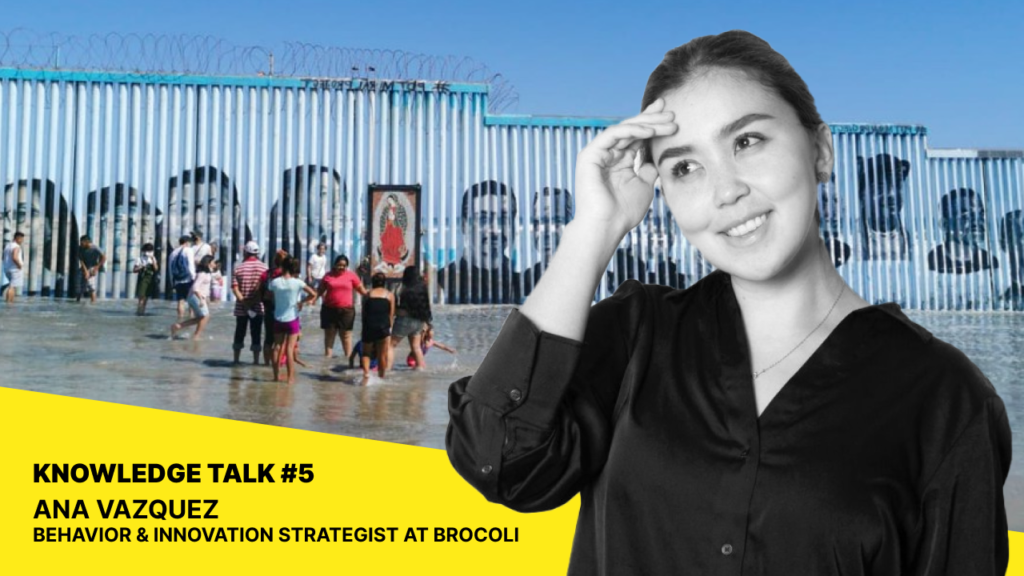
Anna Vazquez, behaviour & innovation strategist at Broccoli – Knowledge Talk #5
- Knowledge Talks
Introduction
Ana Vazquez is a social innovation strategist from Mexico, now based in the UK. She has spent years designing collaborative approaches to support migrants and refugees in Latin America, co-founding initiatives such as Mintegra and Coffee for Peace. In this talk, she will unpack common misconceptions about migration, present the context in Mexico, and explain how she helped coordinate diverse actors from government, civil society, academia, and international organisations in the city of Queretaro using a Collective Impact methodology.
She will discuss the challenges of sustaining collaboration when funding disappears and share reflections on how design can help build coordination systems in complex humanitarian contexts.
Resources
Transcript
Ana's Journey into Humanitarian Work
Ana: I started working in a shelter. It was my first experience in Mexico City. It was very interesting because it was a shelter that used to protect Jewish refugee youths, the ones who didn’t know exactly how to develop their careers. For a year, I did research with UNHCR in order to understand better the needs they have and to start creating collaboration with other institutions in order to provide them more educational opportunities.
Later, in 2021, I started working with Sirlo, which is a social innovation consultancy. I worked there for almost three years, and we developed many projects related to social innovation in Latin America, such as in Ecuador, the United States, with the government, with international cooperation. It was an amazing experience. I learned a lot from all my peers. Most of them had more experience than me, so it was a good opportunity to learn more about what they were doing at that time. And there I met a person with whom I did this latest project. His name is Gabo. I think he’s not around, but maybe he’s going to join us at some point.
I collaborated with Sirlo and then, because of the pandemic and many things that happened, I moved to another city called Queretaro. There I met some people working with a German cooperation and they started doing a project related to the integration of refugees and migrants in the city. After having many conversations with them, they expressed this urgency to start creating awareness about this topic in the universities, because at that time they were receiving many refugees in the universities, but because most of the students were not aware of the topic, the integration was very difficult. So I started this small project with a friend of mine called Mintegra, in which we started doing participatory processes within the universities in order to co-create dynamics and different projects towards the integration of these refugees that were coming to Mexico at that time.
Then the German cooperation, after many of the initiatives they did that I’m going to talk about a bit later, founded this network for the integration of refugees and migrants. The name is super big. I started leading many initiatives. I believe that this is one of the most important successful initiatives we have had in our city because it was the first time that the academia, the government, the international cooperation, and the shelters started working together. So it was super important.
Later I started being more involved. I started trying to learn more and to know more people that were doing the same projects that I was doing at that moment, and that’s how I started being in touch with Humanitarian Designers and also learning more about other projects that were taking place in other countries. At the same time, I founded a small initiative called Coffee for Peace, because the organised crime started taking control of many of the cities in Mexico. I tried to raise awareness towards the importance of peace building in the city.
Later, with my friend Gabo, after everything that happened last year with the crisis in humanitarian assistance globally, he shared with me this idea of starting to do again the kind of projects we were doing in the past. That’s how we started working together at Broccoli, and it started working with the network for the integration of migrants and refugees in Queretaro. Right now I’ve moved to the UK, and I’m trying to do the same and also sharing a bit about the experience I have had in Latin America with the community here, and trying to also learn more in order to share this knowledge with Latin America and also with my peers here. So pretty much this is the journey related to humanitarian assistance.
Medha: Yes, I think we can continue. Thank you, Ana.
Interactive Quiz on Migration
Ana: I’m not going to be able to see your responses, but before continuing, I would like to know the knowledge you have about migration. So I’m going to share with you some statements about this topic, and if you agree, I would like you to put the thumb up. And if you disagree with these statements, to put the thumb down. Is that clear?
Medha: Yes.
Ana: Super. So the first statement would be: migrants are people who have been forced to flee their homes due to armed conflict, persecution, human rights violations, or other serious threats. What do you think? Do you think it is true or not?
I cannot see your responses.
Medha: Would anyone like to speak? Please feel free to unmute yourself.
Ana: What do you think? No one? I would think that everyone knows that this is completely false. Why? There are different things. Migration refers to the movements of people from one place to another for various reasons, while refugees are people who have been forced to flee their homes due to armed conflict, persecution, human rights violations, or other serious threats.
The second statement. I’m trying also to know more about what you know about Mexico and the situation we are facing right now. So: Mexico is considered a country of transit point for migrants and refugees. This means that they pass through Mexico with the aim of reaching the United States, but they don’t stay here. What do you think? If anyone wants to share what you think, it would be super helpful too.
Medha: I think we got like three yeses.
Ana: Three yeses, and the rest?
Mathild: Pondering.
Ana: So it is false. This is very interesting. Mexico functions both as a transit and as a destination country. Recent restrictive US migration policies have led more migrants to settle in Mexico. So maybe at the beginning it used to be mostly a country of transit, but in the latest years, it has started being more of a destination country.
The last one. The number of refugees rose from 27,100,000 in 2021 to 35,300,000 at the end of 2022. This is the highest figure on record. What do you think? Is this number correct? Who says it’s more? It’s less?
Cedric: Right.
Misha: I’m starting to suspect all of your questions are false.
Mathild: I’d say more.
Ana: You would say more. It’s because here we are counting, we just have the data to 2022, but I’m pretty sure that in the latest years it has increased. This is actually true. This amount represents an increase of 19,000 people compared to 2021, exceeding the population of Ecuador and the Netherlands. So there are tonnes of refugees around the world. One in every 774 people has been forced to flee.
So it is a big number. And the last one: in Mexico in 2021, we reached a record of 130,000 people, making it the country with the third highest number of applications in the world. What do you think? Is it true? Is it false? Someone wants to share?
Cedric: I suppose countries that are next to countries in crisis are usually the ones receiving the most migration. So usually it would be like Turkey, countries next to Syria. More in the Middle East. I suppose it can also happen in Africa. So 130,000 is a high number, of course. I wouldn’t know if it is the third, because I think Turkey maybe is like a third of its population, a very high number available around the globe.
Ana: So again, this is the data that a person from UNHCR gave me yesterday, and she told me that they need to keep learning the recent numbers. But actually this is true. The main reasons are because of the violence, the political instability, and economic crisis in countries such as Honduras, Haiti, Venezuela, and El Salvador, also because of the stricter border and migration policies in the United States that limit the onward movement. More migrants are remaining right now in Mexico and seeking protection through institutions such as COMAR, which is the organisation that protects refugees in Mexico, supported by organisations such as UNHCR. It’s very interesting that in 2022, it ranked second with more than 118,000 individual applications. So it grows a lot. Since I arrived in the UK, tonnes of people have been telling me, “There are no refugees in your country at all,” and that’s not true. We have been receiving tonnes in the latest years.
The Context of Migration and Asylum
The Migration Context in Mexico
Ana: So I’m going to share with you a bit about the general context in Mexico. Mexico acts as a country of origin, transit, destination, and return. It has received tonnes of asylum applications in the recent years, and we have a lot of displacement in the Americas. This is what I told you before: because of the violence, the economic instability, climate impact also. The Mexico asylum and protection system plays a key role in ensuring safety, rights, and integration opportunities.
It is important also to mention that the right to seek asylum is a fundamental right under international law, and states must protect people fleeing persecution, violence, or threats to life and freedom. This is something that Mexico has been providing in the latest years. The difference between migrants and refugees: migrants are those who are willing to move voluntarily because of work, education, or their family, meanwhile refugees are those who are forced to flee due to persecution or serious threats, and we are receiving from both groups.
Talking about the legal framework: in 1951, Mexico signed the Refugee Convention, and in 1967 we also started being part of the protocol for the protection of refugees. The protection system is right now managed by the Mexican Commission for Refugee Assistance, called COMAR, and this started in 1970. Today, as I told you, there have been record asylum applications. Most of the people that we are receiving are from Honduras, Haiti, Cuba, Venezuela, and El Salvador, mostly because these countries are facing dictatorships and also there are many organised crime groups within our countries. So even though Mexico has tonnes of organised crime groups too, people think that in our country they are going to be safer. The trends reflect displacement across Latin America and the Caribbean.
Migration Routes and “La Bestia”
Ana: So this was pretty much the context in Mexico. I’m going to show you: there is one train, this one that you can see on the right. This is called La Bestia, or “the Beast”, and it goes from here along the red lines and crosses the whole country. There are many people that come from South America that are trying to get on the Beast in order to cross and get to the United States. The red circles are the shelters and the white lines are the principal migration routes. People tend to cross through these routes by walking, by bus, they are trying to find many ways to do it. They don’t care at all.
It is quite interesting: here in the centre, it is called El Bajio. The main movement crosses this little state that is Queretaro, where this project that I’m going to present to you took place.
Building Integration in Queretaro
Ana: So what happened in Queretaro? Around 2010, it started being an important place for transit because of the train. It was just a corridor and the migrants used to just stay for resting. But then in 2019, big groups called caravanas, I don’t know if you heard about them before, started crossing the country. Big groups of maybe 500 people started crossing together, and these groups were mainly from Haiti and Central America.
When this happened, I remember that in Queretaro the government realised that they didn’t have any tools in order to provide the humanitarian assistance that at that moment the migrants and refugees required. So they started asking for help. And exactly in that year, other important organisations such as HIAS and UNHCR arrived and started doing a programme related to the integration of refugees and migrants. Also, one of the most important shelters opened. The shelter was called Camita, and this is how Queretaro started being in the eye of all the refugees and migrants, because we had this programme of integration.
What happened after? The German cooperation arrived and they started doing many things. They started working with the government; for instance, they started providing capacity building to the government, creating public policies, and promoting the inclusion of refugees and child protection. They were also working a lot with the academy and the legislative group.
In 2023, the network for integration emerged. As I told you before, this network was very valuable because the main aim was to create a shared agenda with all the actors that were working together. We started identifying intersections, needs, and areas of opportunity in order to promote the enjoyment of rights. We coordinated efforts to address needs, because before that, each of the actors used to work by themselves. They didn’t have any intention of working together. So this was the first time that we started collaborating in many initiatives. This has strengthened the communication and the networking, and it helped a lot in the process of raising awareness with the people from Queretaro about human mobility through cultural and integration initiatives.
Over the last three years, I think we developed almost 25 different initiatives and many other actors started getting involved. For instance, Tent, I don’t know if you have heard of them, but this is the foundation of Hamdi Ulukaya, the founder of Chobani. He is a refugee that arrived in the States and started his own foundation in order to help refugees get better jobs. Later they arrived in Mexico and we started collaborating a lot with them. Also, other groups that had the will to provide scholarships to refugees started working with the universities in our city.
We contacted an organisation that was doing a documentary about what was going on in Gaza, and with the help of many lawyers, they were able to bring a family from Gaza. They did a very interesting documentary about their life and about all this process that took place last year to bring the family. That was super cool because we were not only able to watch the documentary, but also the family went to the city and we were able to discuss the documentary and what is going on in Gaza with them. Most of the people in the city that didn’t have any idea about what was going on there or about the situation of human mobility started being more aware. Other activities that we developed last year included, for instance, for International Children’s Day, we did an activity with many refugee children in order to teach them about their rights, and tonnes of university students helped us to organise it.
We have been doing tonnes of activities towards this topic, and I believe that we started being one of the most important organisations in our city. People are more aware about this topic.
Challenges and Funding Cuts
Ana: This happened from 2023, but unfortunately in 2024 we started having many challenges, just as most of you, I am pretty sure. We started having a lot of funding reduction. Because of the war in Ukraine, for instance, UNHCR decided that Queretaro was not that important, so they closed their office. The German cooperation, HIAS, most of the most important organisations closed and they started focusing more on the borders in the south and in the north.
With this, we faced many problems, but still we tried to figure out and to continue working together. But it was in 2025 that things got more difficult. Camita was one of the most important shelters in our country and it was settled in our state. It was receiving funding from UNHCR. At the end, they needed to close. There was no funding at all. Many other organisations stopped working.
It was very interesting because at that moment, I remember I was talking with many of the stakeholders and we were trying to figure out what we were going to do. We knew that this topic was very important, but we didn’t have any funding and not even support from the government. After trying to figure it out, we decided to continue. We also found out that we were having other problems. We found out that there are some shelters from the state that are not supposed to work in all the states because most of them violate basic human rights. We found out that one settled in our city that was not supposed to be working was bringing refugees and migrants in a random way. We didn’t know why.
There were many asylum delays. People used to receive their certification of asylum in maybe one month, and it started taking more like three or four months. So refugees weren’t able to work, weren’t able to continue their lives because they were not receiving the documents needed. The government started limiting their access to rights, for instance to education or basic health services. The police started having a lot of xenophobia and racism against them. We talked with some migrants that told us they were being stopped in the streets and hit by the police without any reason.
We were facing all of that without any funding, but at that moment, after learning about these problems, we decided that we didn’t need funding, that if we really wanted to do something, we just needed to start working together and figuring out with the resources we have. And that’s how we started thinking: what if, against all odds, we remained resilient by co-designing strategies and working together?
Medha: Ana, I just, sorry to interrupt, but we’re 43 minutes into the call. Just wanted to also tell you that we’d like to open it up for questions and answers, so if we can wrap it up in maybe five more minutes, if that’s OK. But I don’t know how much you’ve got left. Sorry for interrupting. Go on.
Collective Impact Methodology
Ana: Sure, no, it’s OK. I was just going to tell you what we decided to do at the end of the year. With Broccoli, the consultancy with whom I have been working for the last year, we decided to do this project. We started knocking on doors and trying to get the academia involved, and we were able at the end to invite people from the government again, from international cooperation, the local shelters, and people that were passionate about this topic. We developed this design methodology called Collective Impact. I love it and it is really powerful because it says that organisations, no matter how capable they are, cannot transform an entire system on their own, but they can do it when they have a shared vision, a strategy, or they can coordinate mechanisms that could be sustained over time.
With this in mind, we started developing this methodology based on five steps: designing a central support organisation, designing a common agenda, reinforcing mutually the activities we have, having continuous communication, and always measuring the strategies we were developing.
Pretty much that’s what we did. We started with research, interviewing refugees and migrants, interviewing many actors from the system, and there we understood better the good practices each of the actors were having, which challenges they were facing, which were their main strengths, the services each of them had, and which were also the main tensions that were there among these actors.
After that, we designed a system mapping in order to understand all the actors that were involved and how we could involve them in a better way, also understanding the interests of each other. We mapped actors from the government, civil society, international cooperation, academia, legal clinics, the migrant communities, and also journalists.
Then, with all this information, we designed a workshop that took two days. The first day, we tried to mix them and to create an exercise of problem drilling in order to understand better all these problems and their roots. We found, for instance, that there was a disarticulation in the organisations, there was a lack of shared data, there was a lot of xenophobia, and also a lack of political will.
At the end, we prioritised. We decided which problems we wanted to start working on, what we could do with all these things we had already understood. We decided that we wanted to work on three axes. The second day, all of us worked together for maybe six hours in order to design which quick wins we wanted to have in the first 90 days, which was going to be the deep work from six months to twelve months, and also to design some indicators and governance agreements we wanted to have in this collaboration.
We had many tangible outcomes. Tonnes more actors started being involved. We designed a one-year agenda, defined clear indicators, and assigned responsibilities. It used to be, to be honest, I was the only one leading this process, and at the end many other actors started raising their hands in order to have more responsibilities. The main output was not a document. It was a shift from parallel action to coordinated intention.
Pretty much this is what we did. In 2026, I can be very proud to share that the most successful thing we have done is the strengthening of this network for integration.
Some quick reflections: collaboration needs architecture, goodwill isn’t sufficient without structure. Design is political: facilitation shapes power distribution. Data is a trust mechanism: shared evidence reduces institutional egos. Leverage points matter: trying to fix everything collapses momentum. Design the governance, not just the service: humanitarian innovation often overlooks coordination systems.
“No compitas, haz compas” is a Mexican phrase, and it means “don’t compete, make friends”. Try to understand the people that are passionate about the topic you’re working on, and you’re going to find out that you have a big team willing to work towards the impact you want to see in your community. And pretty much that’s it.
Q&A
Medha: Thank you so much, Ana. I think that was brilliant. Sorry to have rushed you through towards when you were explaining your process. As you rightly said, “no compitas, haz compas”. I think that was a beautiful way to conclude your presentation. I open it up for questions and answers, if anyone has anything that they’d love to ask Ana. If not, I do have my questions. I’ll give the mic to everyone else.
Ana: Sure.
Medha: Cool. So maybe I can begin. I think I have two main questions, but I can start with the one that’s on the slide right now. The third one says “data is a trust mechanism” and that “shared evidence reduces institutional ego”. I think I completely agree with that. I was on a project for policy recommendations for one of the New York City offices, and it was so hard to establish that trust mechanism. Even though we knew that this is true, the city offices, or their different departments within themselves, also did not fully trust each other. Each one had a very different process, different software, or different ways of storing data that they followed, and no one had a standardised way to collect data or share data with each other. So I would love to know more around your process of developing this trust mechanism of shared evidence. How did that come about?
Ana: It’s so important. When I started working with these actors and interviewing most of them, I didn’t understand why some of them had certain information and the others had different information. They were working on the same topic but weren’t able to share this data. At the beginning, they used to say that they were worried about this data and that they wanted to protect it, and I completely agree with that because it is very sensitive. But if all of the actors are trying to find the same solution and working on the same problem, why wouldn’t they want to share this information? I believe that sometimes we can start developing a solution, but if we don’t understand really well which is the main problem, which are the main challenges, the solution is going to be incomplete or abstract.
After having a conversation with all these actors and letting them know the price we were paying because we didn’t have all the information we needed, they understood and were open to share the data they had. But before that, it was very complicated. These egos are very dangerous everywhere. I think it’s very important for us to always share the value of having this information and what the main goal of all of us is. I don’t know if that answers your question a bit.
Medha: No, I agree with you. I think if we could show them the value in sharing and maybe set protocols around privacy or just protecting data and how it could be shared, I completely agree with you. Thank you for sharing that. Again, open to anyone for questions. Otherwise, I do have a second one.
Question (Cedric): I can have a quick question about what you’re doing now. You moved to the UK, is that correct?
Ana: Yes. I am still in touch with this network all the time. I’m very proud because, to be honest, I have been leading this initiative for the last three years maybe, and I was a bit afraid that moving was going to represent that this initiative was going to stop. At the end it didn’t. I just left them and I believe everyone has very clear the responsibilities each of them has. Sometimes I am just a consultant: they reach me when they have questions or don’t know how to do something. The network is working perfectly. I’m just getting in touch once a week or so.
Right now, I was sure that I didn’t want to stop working in this area. I started reaching other organisations that were doing something very similar. Right now there is this organisation called Network for the Rights of Migrants, and they’re super similar. They are doing tonnes of awareness campaigns about migration here in London. They are also designing tonnes of public policy and raising many campaigns.
Right now I am leading an initiative in order to create awareness and to do artistic initiatives to talk about migration. It is quite interesting, to be honest, because even though it’s the same topic, the dynamic is completely different. I don’t know if some of you have worked in this field, in migration, but it is quite different how this behaves in Latin America and in this context. So I’m willing just to learn and to share experiences from one side to the other.
Question (Sofia): Thank you for your presentation, it was super interesting. I would like to know maybe a bit more because I’ve worked a bit with government in Europe, in the north part of Europe, and I feel like governments are very open to participating in this type of workshops. In terms of policies, what do you think? In Latin America, are the governments open to design interventions or more innovative ways to approach this?
Ana: In Latin America, not that much. It’s very complicated. I think that something that distinguishes Latin America is that most of the civil society organisations have learned how to figure things out by themselves without depending on the government. Their interests are completely different. But I think that in our state we are very fortunate because there are, not everyone, but there are some people that are willing to understand better the topic and willing to do things. I think we cannot not work with the government. There are times in which most of my peers try to just do the initiatives without them. I think we cannot do that, but we can try to understand better which are their interests and which interests we have in common.
For instance, we knew that the Secretary of Education started having tonnes of children that were migrants from other countries, and because they didn’t know about the topic, they didn’t know what to do. They didn’t know how to validate their studies, they didn’t know how to help them integrate in the schools. When we found out that they were having this problem, we proposed them an initiative that was responding to their interest but also to ours. That’s how at the end they agreed to collaborate with us. Learning about the interests they have has been one of my main learnings these last years.
Sofia: And in terms of results, do you think they are… because sometimes I feel like these people are very result-oriented, they want to see things in the short term.
Ana: Yes, that’s true. But I think they have told us many times that most of the things we have designed and done in the past, even without funding, have been better than the initiatives they have done with funding. So the results we have had are very clear, and that has helped in order to get their trust and to start working together. Also, another thing is that you cannot expect them to do things without knowing exactly what you want them to do. We need to be very precise and very punctual in the things we need from them, and also to understand their constraints. If they can help us with this resource on this day and just that, and if they have that clear, it has been easier for them and for us to collaborate together.
Closing
Medha: Thank you, Sofia, for your question. Thank you so much. I think we’re a couple of minutes over time. I just want to thank everyone who’s joined today, super grateful for joining into this conversation and also thanking Ana for sharing all of her wonderful work today. People like you who are bridging the gap between design and humanitarian fields, it’s beautiful to see how your work helps do that, and we look forward to more conversations. Please, everyone, feel free to reach out to Ana with any questions or just connect to our conversation. I will definitely be in touch. Thank you so much for joining today.
Ana: Thank you so much. I didn’t see, Iris is here. Iris has been one of the best stakeholders I have worked with. She’s from UNHCR. So thank you, Iris, for coming and thank you for being part of this space. And thank you, everyone.
Medha: All right. Thank you for joining. Iris, Camilla, hope to see you in our next talk. Take care. Bye.
Misha: Thanks, everyone.