
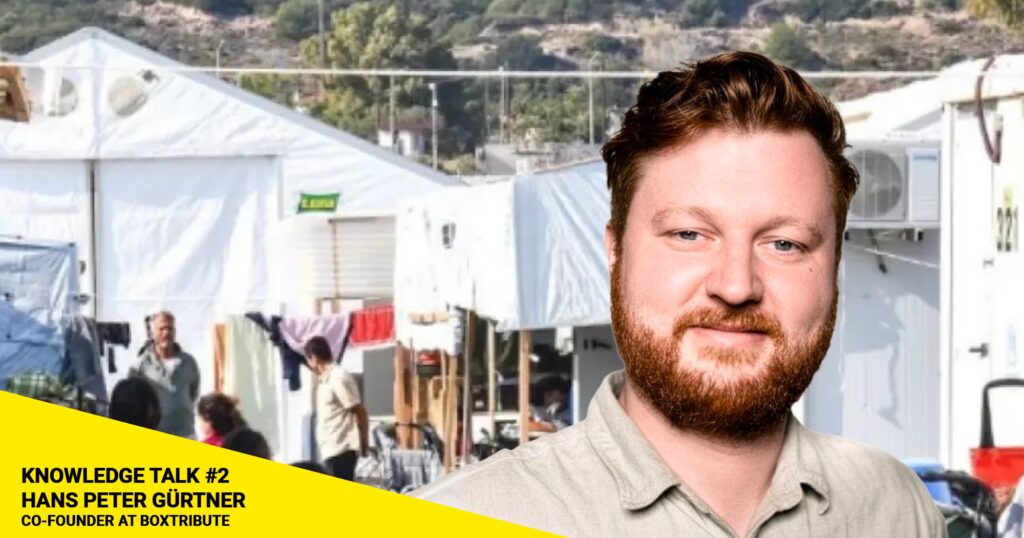
Hans Peter Gärtner, co-founder of Boxtribute – HD Knowledge Talk #2
- Knowledge Talks
Introduction
Hans Peter Gärtner is the co-founder and tech lead of Boxtribute.
Transcript
Medha: Thank you again everyone for joining our community discussion. We have another knowledge talk lined up for you today with Hans from BoxTribute. He is the co-founder and tech leader at BoxTribute, which is a warehouse and distribution solution built for grassroots NGOs. Today we will be talking about how BoxTribute has collaborated with local organisations across multiple locations. Last year, their team also conducted a research trip across Ukraine borders, the Balkan route, and Lebanon, deepening their understanding of the evolving challenges faced by local actors. I invite you, Hans, to take it away and introduce yourself and maybe delve a little bit into your journey of coming into this field.
Hans: Thanks for the introduction. If there are any questions, please raise your voice because I do not see you; I just have one screen at the moment. I am Hans. This is an older headshot of mine from almost 10 years ago when I started. I think this is actually in Athens in 2016, unloading a truck of aid goods which arrived in Athens, and that is also my starting point.
If I talk about my background, I actually studied physics in Munich. I volunteered there already for refugees and, after my studies, I had a phase where I had not that much to do, so I just went for it and went to Greece to volunteer in a refugee camp in northern Greece. Back then, Idomeni was still a thing, the camp close to the northern border of Greece to North Macedonia. In that time, I was volunteering for a Norwegian organisation called “A Drop in the Ocean” and became later on their warehouse manager. During that time, we created a first prototype of BoxTribute, and my story began. Since then, it has been connected with me.
I have one or two older pictures from back then. When I arrived in the Thessaloniki warehouse in September 2016, you had a lot of donations coming in from all over Europe for this, back then, relatively new refugee crisis. It was quite chaotic, especially when you have a lot of volunteers and local people. Most of them do not have knowledge on how to store logistics processes. Many people just stay there for a short time and many people touch things; it becomes quite chaotic quite quickly. In many new places where you work with smaller organisations, it still looks like this.
Regarding distributions, you have a picture on Chios island I visited later for a distribution of goods on the beach. This was also very chaotic. You have a lot of queues and you do not have a fair choice. Queues are quite an unfair process. It was just very chaotic. We started back then in northern Greece when Idomeni was closed down and a lot of refugees were distributed to different camps. We created our first free shop where people could come and just use what they need instead of being given a pre-packaged bag of aid goods. For us, this was a much fairer process and more dignified because people are treated like a customer and not somebody who is begging for the aid goods. They can choose what they actually need, and that is the more efficient process.
That was our beginning. Over the years, we implemented it in Chios as well as in the Netherlands. With the same organisation, we open-sourced the codebase because we built software to run these free shops. We open-sourced this first prototype and thought possibly many other organisations could just use our codebase. However, when it comes to these small organisations, they usually do not have the IT personnel, so even though the code is there, nobody is using it if you do not offer it to them.
We were asked by quite a few other organisations because they knew how well-organised A Drop in the Ocean was, and they approached us to see if we could implement with them as well. We decided in 2019 to make our own organisation out of it and turn this prototype into a Software as a Service product for local organisations to help them in their warehouses and with their distributions. Now, we also help generally with registering activities with beneficiaries. We are currently used in these locations: we have a foot in the door in the Middle East, still quite a bit in Greece, and on the borders of Ukraine. There are a lot of sending organisations in Germany. This graphic is about one year old; there are a few more in the UK now and an additional one in Italy. Until now, we have worked with about 35 organisations in 50 locations, and all of these were rather small, local organisations.
Here is a quick image of us behind the app. That is just our normal meeting room; we have an online office. We work remotely. We have hired a few new people, so the team got a bit bigger. I will mention at the end that we have an open position for a designer as well. This was the history of how I started and how I got introduced to the field.
I have two more sections. One is what BoxTribute is, so you understand a bit more on our features and functionality. Then I also have a part on what we learned over the last years from working with these small organisations. We did research work last year through the Balkans, on the borders of Ukraine, the Greek islands, and in Lebanon. I can present the learnings from those.
What is BoxTribute? If you look at these scenarios, you see BoxTribute in the red circles. We have a system of labels with QR codes to track stock and aid goods. On the computer, people are registering who is receiving what kind of aid or service. We have a very simplified warehouse management. The situation in the field is that most local organisations do not have a logistics background, so they need software which breaks down this process to a simple one they can do on their phone. This part is the most impactful because the logistics process is the most generalisable across regions. All organisations first need to know what they have currently in stock to figure out what they need to get or what they can distribute. Usually, they have a tough time figuring out what they currently have. Some of the more advanced or professional organisations are probably planning what is inbound and outgoing so they can plan resources next.
It is really for us that we see our biggest impact in this part: helping them introduce some kind of structure with the app. There are now also parts where organisations can share stock and coordinate better. For example, if you are sorting and collecting something in Germany and then sending it to Lebanon, you can take over these items with transfers without needing to re-sort anything. With these QR codes, you have a view on your phone of a box or a single container and you get an overview of what you have. You will also have statistics on what is coming in and going out.
On the other side, I would call it a beneficiary CRM. We started with distributions and registering beneficiaries in a GDPR-compliant way. Back then in Greece, most people used Excel sheets or Google Docs. We enabled these smaller organisations to be GDPR-compliant. They registered beneficiaries and distributed tokens or currencies that they could use in the free shop. Now they can also register services they provide to them and track their beneficiary reach.
As we learned over the last year, for the local organisation, especially when reporting to their funders, the most important metric is beneficiary reach. How many beneficiaries did you reach with your service and how many unique beneficiaries were there? This is something we focus on now and we are getting more flexible. However, as I mentioned before, warehousing is a process that is quite similar everywhere. How you do distributions and track beneficiaries can be very different between regions, especially in a camp context or with beneficiaries on the move.
At the end, we are a software company for local organisations. Since we interacted with many of these organisations, we tried to summarise what we learned to improve. One big learning is that localisation -moving aid delivery towards local actors- is now widely accepted. In 2016, there was the so-called “Grand Bargain” between the largest INGOs who decided to focus more on localization because it is more efficient. These local actors know the context better and it creates more resilience. They committed in 2016 already that these local actors should get more funding, specifically 25 per cent of donations by 2020. However, we are still quite far away; we are currently at four or five per cent.
Over the years, we focused our mission on helping these local organisations, helping them get more funds, giving them more visibility, and introducing more transparency into how they work. For our research trip last year, we wanted to understand local organisations from different regions even better. We mainly went to Ukraine, the Balkan route, and Lebanon. What we learned during this field research is that we usually see four actors in the field:
Newly started local NGOs: These are personal networks that directly try to help with a local problem. They usually do not have structure and create it on the go.
Established local NGOs: These are organisations like the fire brigade or sports clubs that have established structures and knowledge of accounting, and step into emergency aid.
International grassroots: Actors from other countries who go to the field without national NGOs to volunteer or start something new. This is common in Europe, but we have not seen it as much in other regions. They have less connection to the local context than local NGOs.
INGOs: They come in a bit later and are not as hands-on as local actors. They often speak a different language and have a high demand for reporting and accountability. They prefer working with established local NGOs because they have some governance in place.
Local actors have the advantage of knowing the local context, but they lack resources and experience. I want to go a bit deeper into the crisis life cycle. The curve you see here is the attention curve. There is a sharp rise at the beginning to a peak when a new disaster happens, and then it slowly fades over time. In the beginning, there is a “rescue gap”. The disaster just happened and there are only local actors who lack resources and knowledge.
Towards the peak of the curve, good grassroots organisations use this momentum of attention to generate resources. However, when they reach the peak, there is a very strong focus on operations. If they want to help for a longer time, they need to quickly professionalise and seek diversified funding. INGOs often fund local NGOs initially but pull out quite quickly after the first response because they are underfunded. These grassroots organisations then often die out or find another way to fund themselves. It is very rare for grassroots to decide themselves to step out of the field. We also see frustration where local organisations feel that INGOs claim their impact.
BoxTribute unfortunately often comes in after the attention curve, when these grassroots see they need to professionalise. We are most impactful when we come in early. For example, in Krakow during the Ukraine crisis, we supported a warehouse in an old shopping mall with 300 volunteers that supported 250,000 Ukrainians. They told us that without our process being there in the beginning, they would not have been able to scale those operations.
Our aim now is to get earlier into the curve. Since we are a small team, we cannot deploy to the field ourselves, so we need somebody else to do this for us. Our approach is to reach out to capacity builders and funders. We would love to do joint trainings and shared services with INGOs to get early into the field. We are also trying to develop a data product. We have a lot of operational data which could create transparency and visibility into these local organisations. We might be able to sell this to funders who want to fund local organisations but do not trust them and ask for a lot of reporting.
There is an open position for a designer who could help us develop this joint service or data product. I would be super happy for any feedback or introductions to INGO capacity builders or funders interested in localisation. Anything would help. Feel free to reach out on Slack. I think I was talking for a long time.
Medha: Thank you so much, Hans. This was brilliant. That was a very heavy, info-packed session. I am currently working as a UX researcher on a volunteer basis with Digital Aid Seattle, and they also provide free tech solutions to non-profits, so it is very cool to see how you focus down on a niche. I am curious about adoption. You mentioned that grassroots NGOs might struggle with limited tech capacity, so how do you ensure they are able to adopt your technology and how do you pitch BoxTribute effectively to them?
Hans: The adoption part is quite easy. We have a standardised onboarding flow. As a Software as a Service product, we just send out a login. They need to define warehouse locations and products, but you can do this within a day. This is different from a company ERP system for warehousing, which usually requires three to six months of preparation. We focus on making adoption as easy as possible. Our problem is reaching them; we are not as well-known as an actor that a local organisation finds automatically in a new crisis. Most of it at the moment is word of mouth. We are trying to piggyback on INGOs so that if they are going to the field to build capacity, they could have us as an offer as well.
Cédric: Do you know the H2H network? Do you see an added value for Box Tribute? Could that help you to reach out faster or just to connect with others to get access to funding?
Hans: Yes, we do. We are currently in the process of becoming part of it. Access to funding, yes, possibly. It is a value of trust between the HTH network members. We are already in talks with at least one consortium there. Being part of HTH adds a bit of trust so that you are not a random actor. We got good introductions from them. Besides that, we are targeting capacity builders and funders.
Cédric: Is the UX/UI position to work on the app specifically, and is it in the field or remote?
Hans: The position is remote. It is not just UX UI. We have a few things we want to polish in the app, but especially when we talk about capacity builders, we could think about how we share knowledge. The main problem of local organisations in the beginning is they have no funds and less knowledge on how to react to a humanitarian crisis. With capacity builders, we would love to add some kind of training or learning design. Since we want to approach funders with data, figuring out how to show the output of local organisations to funders would also be a task.
Medha: Do you have a presence in the US as well, or are you currently only around Europe?
Hans: We had a bit of a presence in the US last year in terms of usage. Our team is very distributed. Rana, our managing director, sits in Hong Kong and I sit in Berlin. Last year there was a larger hurricane and we worked together with another organisation called Distributed which had a large network in the US. We had six locations in the US who also applied our software. But as it is with natural disasters, demand comes and goes. Usually when the natural disaster is over, we do not have anything concrete there anymore. There is one in Puerto Rico at the moment where we are having talks for disaster preparedness for the next hurricane.
Medha: Since you were speaking about disasters, has there been a moment with Box Tribute which significantly accelerated your response because there was a crisis and a sudden influx in how your software was being used?
Hans: I think the biggest one for us was Ukraine. You had quite a few actors who used us or knew us from Greece and moved over to Ukraine. There was a huge spike in our statistics regarding how much was moved in aid goods. It was interesting to see in Germany. There was an organised group of organisations after the Greek response. They formed their own union and managed to send trucks to Ukraine from all over Germany from private donations without any large international organisations behind them. The Ukraine crisis was a huge catalyst. But you see now with less attention and fewer donations, the willingness for company donations declines.
Medha: Does it affect BoxTribute at all when it declines?
Hans: A bit, for sure. Our payment model is that we ask a fee for the local organisations to pay for our domains and basic maintenance. We see a value in it; if they pay for something, they see it with more value. But it is a small fee. On top of that, we fundraise ourselves to produce new features or to do research trips.
Medha: I would love to use the app too if possible, just to play around with it.
Hans: We have a staging login. We have a lot of demo data and you could put in whatever you want. If you look back at it, the biggest impact we still have is with the first idea of QR codes and making it easy to get an overview. Our approach now is actually more on outreach. It is also quicker for us with AI in the background to prototype new things, so we are shifting our focus more now towards relationship building and reaching out to new people.
Medha: I think we have only a minute to go. I just want to thank you very quickly, Hans. I could hear a lot of passion as you presented today. Thank you so much for taking time out of your busy schedule to bring us all of this insightful knowledge. I especially love the crisis lifecycle slide. If you could share that with us, that would be amazing. Thank you so much for spending time with us today. Have a lovely rest of your evening.
Hans: Thank you.