Roderick Besseling on Data & Analytics at Norwegian Refugee Council – Knowledge Talk #1
- Knowledge Talks
Introduction
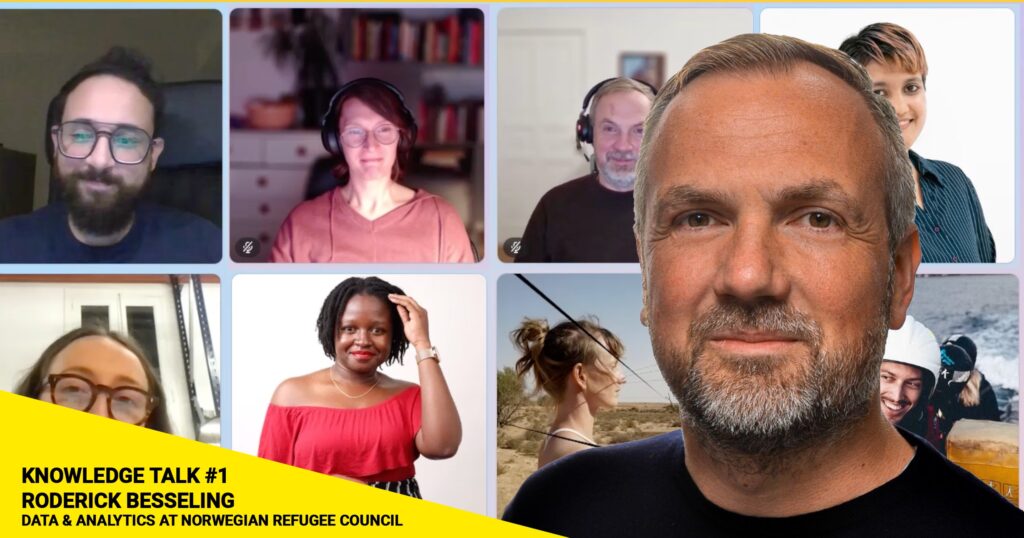
Roderick Besseling is the Head of Unit for Data & Analytics, and Irena Lämmerer is a front-end developer; both work at the Norwegian Refugee Council and are replying to questions from the host Medha Dhoundiyal.
Transcript
Medha: I am a part of the first volunteer cohort of humanitarian designers. Just a little bit about humanitarian designers. It started in 2021, January. It’s the grassroots NGO and we have three missions which you can think of as building bridges: one is to raise awareness in the humanitarian sector about the added value of designers. Another is to communicate to designers about the humanitarian sector and also we want to support our community members who would like to develop their career as a committed designer in the humanitarian sector.
We also have some activities that are part of these missions. One is education where we teach and learn about humanitarian design. Then we have also communication which is around developing the narrative of this field because it’s quite unique and also just the development of our NGO.
Cédric and Gwenn, please feel free to add more. They are co-founders along and diving straight into Norwegian Refugee Council. It is a great pleasure to have Roderick and Irena from Norwegian Refugee Council. Thank you so much for joining us today. We’re very grateful to have your presence.
A little bit about the organisation. It is an independent humanitarian organisation which helps people who’ve been forced to flee. They protect displaced people and support them as they build a new future and they also started relief efforts after World War II. Today, NRC works in both new and protracted crises across 40 countries and specialises in six areas: food security, education, shelter, legal assistance, protection from violence and water and sanitation and hygiene.
We have from NRC today Irena who’s a front-end developer at NRC with over a decade of experience bridging design technology and purpose. Before joining NRC, she worked in junior with DLR Project TREGO and KLab EDU Media, developing research and education platforms that balance usability with complexity. Her earlier roles at SAP Innovation Centre for University at Berlin and in graphic design and E-commerce reflect a career rooted in both technical craft and creative problem-solving. Irena brings a thoughtful approach to building digital tools that empower people and make information more accessible.
That’s Irena and on Roderick, he leads the data analytics at the Norwegian Refugee Council where he guides the organisation’s digital transformation, data governance and analytics strategy with a background spanning digital strategy, open data and humanitarian innovation. He has helped shape NRC’s approach to evidence-based decision-making and responsible data use. Before taking on his current role, he served as senior advisor for open data and product manager for transparency and open data, advancing initiatives that strengthen accountability and organisational insight. His career blends leadership, design thinking and a deep commitment to using data as a force for better humanitarian outcomes.
I would now like to invite both of you to share your thoughts and journeys to NRC and what you currently do there. How did you both actually get started and reach the work that you do now and what motivated you to bring your technical and design skills into the space? Whoever would like to start. Just your journey and thoughts.
Irena Lämmerer: I studied computer science and I originally had a design path in mind. I’ve always been keen on the topic, but I ended up in computer science. The interest was just always there, so I ended up in front-end development. It’s just a nice way to combine the two. I’ve always wanted to use my skills for something good or useful, so I started out with some educational web apps, delivering educational content or bringing people together in an educational context. Then I was looking for something else and found the humanitarian sector. That was quite the epitome of useful. I joined in 2021 and have been working on web apps here too since the beginning, different web apps. There have also been a few attempts on developing our design system, which I’ll get to later. I’ll leave it with this for now.
Roderick Besseling: For me, yeah, you did a great job already introducing my background, so I won’t go and recap all of it. I also started with attempting a degree in computer science, but it’s something I’ve never actually finished. It did give me a basis in technology and digital, which I think brought me to where my career is. But after taking a break from studying and just doing some work for a few years, it was time to go back to university and then do international relations and then a master’s in post-war recovery studies. I’m going a bit more into the human sector in terms of the academic sphere. I always had this kind of background in computer science and software engineering, even though I never finished the course. Digital and data, the technology kind of came naturally to me. So things like information management, data systems, data management was always something that I gravitated towards in the different organisations where I worked. The first bit of interesting work was my time in Ethiopia for two years, working at a university in their ICT department. That was really about making digital tools available, but then also empowering and enabling students, predominantly, and also teachers to use those tools.
Yeah, it’s not just about making the tools available, but also making sure that you engage and empower the end users into using those tools. After that, in Ethiopia, I went back to the Netherlands and worked at an organisation United Network of Young Peace Builders, which again brought together young people across the world in peace building endeavours. There we started using different digital platforms, similar to what Medha and Humanitarian Designers is doing, to bring all these young peace leaders together to share expertise about peace building and look for training opportunities among them.
Then I moved to CordAid in the Netherlands, which was also a large Dutch development organisation. There I implemented data collection platforms, monitoring evaluation platforms, so kind of stuck to that; how do we capture data and how do we do something with it.
After that, I took a hiatus from the NGO sector and worked for two donor governments, first in the UK, at the Department for International Development, and then afterwards at the Netherlands Ministry of Foreign Affairs, both working on open data platforms. My responsibility was to make sure that the general public, but also NGOs and donors had access to information and data about what the different donor governments were funding, but also what humanitarian organisations were doing. I enabled that through the creation of two data platforms that I managed and ensured that they met user needs.
In a year before Irena, I joined NRC in 2020. There I started off as product lead and then moved to head of the data and analytics unit, where we work on different data and information products to enable better decision-making across not just head office, but also the country offices where we work. Back over to you, Medha.
Medha: Wow, that was just amazing. I think I’m already quite inspired because similar to both of you, I also come from a computer’s background. However, it’s really funny that I didn’t think it could be applied into humanitarian sectors. I’m discovering only recently and through maybe chatting more with both of you. I have one question that comes to my mind: how does data actually translate or does not translate or what has surprised you the most about how design and data thinking could translate into humanitarian work? Because when you think of data, it’s very technical and for both of you to be working in a humanitarian space, how do you translate that data in such a space?
Roderick: There’s different aspects of it. Of course, there’s the whole data lifecycle collection process about how you structure data collection, how you analyse the data, how you manipulate the data, how you transform the data, how you visualise the data, and how you communicate the data, so having a good solid foundation about data and data management skills I think is essential. But also linked to that, what makes data very interesting is then looking more of it from an analytical point of view, but also then evaluating the different products that we make. Again, maybe Irena, you could mention some of the stuff you’ve worked on and seeing if data helped you inform decisions about how you develop things. From my experience, mine is more on managing the data lifecycle and ensuring that the data that we collect is suitable and fit for purpose for what we’re trying to achieve. But also, again, we use data and data points as well to analyse the products and platforms that we create to ensure that they actually meet the internal or external user needs as well. So that’s a double answer on data.
Irena: I could speak more about web apps in general or the process of developing a web app in the context which I would just say has the specific challenges of you might have, like you cannot rely on certain devices of your end users or on performance of the end device or connectivity. So that always needs to be factored in. And user research also is not as easily visible because your users might just be the field staff which is extremely busy and just not prioritising design questions or the actual participants which are, of course, also not always easy to reach for things like user research. Those are humanitarian specific challenges, I would say.
Medha: Continuing along the same line Irena, in humanitarian work, your tools must balance usability, reliability or as you’re mentioning constraints, maybe like low bandwidth or limited access to people. How do you design and develop for such realities?
Irena: Well, first of all, I don’t design, I’m just a front-end developer, I’m not a designer. I just like to design. The designs have usually been done by someone else, if at all, actually in most applications that I’ve seen within NRC, I’m not sure there were any designers involved. Usually it’s just the developer team coming up with the UX. Also, a lot of the web apps actually fail or are not every web app that is trying to be delivered is in the end actually delivered. So it’s kind of hard to get results really. And I don’t really have any right now.
Medha: Right. Roderick, would you like to jump in on that?
Roderick: Yeah, I think accessibility is a big challenge for us. And like you mentioned, that has both to do with connectivity, low bandwidth areas, but also language, of course. If you think about the 40 different countries that we work, it’s not just 40 different languages often, it’s probably about 80 different languages, depending on the context and the environment that we work in. That’s quite a large challenge that we have to make sure that the work that we’re doing, especially within digital systems, that that could be translated to meet the needs either of the staff in country or the participants that we serve in the country as well. So that remains a large challenge, no matter what.
It’s true what Irena said as well. I think that’s the interesting thing about humanitarian designers. There is often not much design or design is often a bit of an afterthought when it comes to creating solutions, both at the head office where we both work but also for our colleagues that work in the field. Some people make best efforts to do some design aspects when they do something. But there’s not often a design process involved about actually doing things like empathy mapping or different stakeholder analysis about how they would use it. I think we’re getting better at things like user acceptance testing. And that’s about the stuff and user feedback. And, you know, doing some more prototypes and wireframing to ensure that the products meet the needs of the customer or the end user, but it’s still not the norm to do it in an agreed central way. Those are my observations so far, not just from NRC, but the sector as a whole.
Medha: Thank you so much for sharing about both of your works and the challenges you’re facing so far and the processes you’re using to handle that. Perhaps it’d be great to also learn about one project or the current different projects that both of you are working on to dive deeper into the kind of work both of you do right now and also how you do it.
Irena: So I currently work on two projects, even though one of them is kind of like fading out because it’s more or less done, which is a web app again, delivering educational content. This is kind of following me. Where again, the design was just kind of done by us as developers without any actual input from designers, just like our best guess.
The second project is the design system, which is more like my pet project. I’m also the only one working on it and it’s more like one day a week kind of project, which of course also is approached by me from a purely developer perspective, so we’re really kind of missing an actual designer’s perspective.
What I mean when I say I’m approaching it from a developer’s perspective is like it’s in React and in Storybook. I’m developing a Storybook page for these React components and it is based on Material UI. And I am focusing more on more complex composited components or templates for top navigation, side navigations, ideally even the full app or more complex things like tables and forms because everything else is already offered by Material UI and I can of course offer theming, but there’s not much use in me developing a new button component if it just does the same thing as the one from Material UI.
So that’s what I’m doing. And the goal is that other developers within the organisation can just use it as a building brick kind of tool when developing apps and have to not think about design, which many of them aren’t already doing because they don’t have the time or the capacity for that. But they could then use this library and still have their web app fit into our general branding and universe of apps.
The current app universe of NRC is very diverse also in terms of tech stack. I think that in an ideal world we would all those apps would have the same tech stack and I think maybe the design system could be a step towards that; like as kind of an incentive for new apps being developed moving to a common tech stack, but it’s unrealistic that existing ones will be migrated. That’s my current project.
Medha: That’s awesome actually. That’s really cool that you have a design system that you’re working on. Roderick, is there something that you want to add? What are you working on?
Roderick: Yeah, of course. I get that. I think Irena’s design system is very cool. I’m a big fan of design systems.
Medha: If the organisation allows it, share it with us just for my curiosity.
Irena: Well, it has never been officially signed off. This is the second iteration really. There was a first one that was never really signed off on and that never really got very far. And the one that I’m currently working on is just on my local computer so far and I haven’t really shared it with anyone. So I can share my screen but it’s not finalised in any way.
Medha: Okay, I’m so sorry to interrupt you, Roderick. I just was very curious.
Roderick: No, again, I think Irena’s design system is great work. One of the challenges with working at large organisations is that we often have to work quite intensely with really poorly designed legacy systems. I think things like Irena’s design system are great for using when we’re trying to develop our own applications, but the reality for humanitarian organisations is that we’re often stuck using big corporate enterprise software like Salesforce, Oracle, SAP. You name it, they’re big, they’re bad, they’re ugly, they take a lot of time and that’s often a lot of the frustration from users is that they know that better can be done and better exists. But often where we’re often stuck using those systems then there’s no hope often in trying to improve them, so there’s a little sliver of hope often to design better interfaces and systems when we have the ability to develop them in-house or together with an external partner.
For the project that I want to talk about that my team has worked on is an AI power, an AI power translation tool. One of the things we work on who have access to is Microsoft’s Power Apps solution. That’s a low code, no code kind of solution where you don’t have to be, dare I say, a proper developer. I don’t know if Irena is going to give me a dirty look if I say that. A proper developer to code or to build lightweight apps. And then within this Power Apps we use an existing large language model for different languages. So we chose French, Arabic, Spanish and English. And then we trained those different models on additional internal documentation and A/B translations from one language to another. And that improved the scoring and the quality of the translation. That was step one. Step two was then to design the interface. First we just created an app, created some boxes, created kind of a rough layout. Then we did a bit of online research to see what our competitor is doing. So we went to Google Translate, we went to the other well-known translation websites whose name I have now forgotten. But again, we noticed that there were some definite patterns how these websites do their layouts, where they place their buttons, the language they use, the UX they use. So we again copied or were closely inspired by the way that they did their layout and interactions as well.
And that led us to create a quite well-received document translation system that is now able to translate PDFs, Word documents, Excel if it wants to, but it also does on-demand instant translations. And the nice thing, because it was trained on NRC’s internal lingo and acronyms and language as well, it often gives or it should give better feedback than if you were to use a public translation service. And also, of course, it keeps the data safe within our own tenant rather than sharing it with the wider translation services that exist.
So maybe I’ll pause on that one. I can also talk about another data platform that we’re working on, but maybe I’ll just pause there for a moment because I also don’t know how much time we actually have.
Medha: Right. Now, we got time for a couple more questions before we open it up for Q&A with people present here. So if you want to expand on your data platform that you’re working on, that’d be great too. And just a quick question before you do that, are these platforms that you’re developing currently for internal use of NRC, or are they something that maybe can be used outside directly by those in affected crises?
Roderick: Yeah, great question. At the moment, the translation tool is internal use. I would say mostly because it’s still quite expensive to do the translations. There’s only so many free credits that we have per month to use the Azure translation model, a large language model. So we do pay a few hundred dollars a month for the translations internally.
But it has, worryingly, we’re very happy, but the business owners decided that it’s so good that they’ve now cancelled the contracts with the translation agencies. Again, from a technical point of view, our feedback was that seems a little bit soon. Please make sure that somebody always reviews what you translate. And everyone’s like, yeah, of course we do that. But again, this is the power of AI. So that, of course, is always exciting and worrying. No, but I think we are happy to share this with other humanitarian organisations. I think we have shared how we’ve done it within Power Apps and Azure. It’s no secret. It’s something, there’s a large language model within Microsoft that you can tap into. We just built a front-facing app for users to use. So it’s really no secret what we did.
The other platform maybe that I want to talk about is something called NRC Exchange. It’s a data discoverability and management platform. It’s built on an open-source platform called C-KAN. And the idea about that was that there’s a lot of different siloed and fragmented data sets within the organisation. And we actually spent quite a lot of time internally asking different people about different data sets or the same data sets. We’re never quite sure what the up-to-date data set is, so we’re designed to create an internal, again, at the moment, data platform to host specific data sets regarding finances, HR, but also slowly a bit more with some of the projects that we’re doing in the field, where they’re able to add information as well. Again, one of the important things for us in this aspect was to learn from what others are doing. So the platform is built on a similar platform as something called Humanitarian Data Exchange or HDX.org. And that is probably the premiere or the go-to place for the entire humanitarian sector to find and reuse data sets to help with decision-making and analysis. And again, our approach was to see what the leaders are doing, be influenced by their design choices. And that’s kind of how we’ve built our platform and how we continue to develop it.
Medha: A quick question on NRC being a very large organisation where you are working alongside many different teams, so there’s design language, tech language, humanitarian language: how do you and your teams bridge these different languages? How do you make sure that development data and humanitarian programme teams actually talk to each other?
Roderick: That’s a great question. The reality is that every few weeks, there’s an email that comes in and this is an emergency: we urgently need something; we urgently need support; we just need this little bit of work; we just need a week of your time or two weeks of your time. And then six months later, there’s three staff dedicated to a project with no end in sight. So yeah, we’re bad as an organisation. I think the sector is bad at scoping and understanding and defining what the actual needs are. That’s problem number one. Often our colleagues that want to create or have a digital solution to support their work, they often also don’t necessarily have concrete processes or workflows in place to do the work that they should do. It’s unfortunately often a little bit ad hoc, which can be justifiable because every situation is different and there’s also very large staff turnover. But the reality is that often when we’re asked to do something or develop something, the ask is unclear and is ever-changing, which makes it difficult for us also to build something. We do have more and more product managers. I think that’s fair to say, Irena, that we have a few product managers and a few people that do business analysis now. That kind of act as this bridge between the digital side and the programme side to ensure that the solutions that we build are the right ones and also to ensure that the needs and the requirements are very clear from the beginning before we kick off a project. Maybe Irena has any reflections on the work that you’ve done on participatory facing platforms or anything?
Irena: One project that I worked on was meant to be global, meaning that 40+ countries have to agree on what makes the most sense for this app in terms of requirements and it was nearly impossible. I’m not on that project anymore, so I’m not sure how they actually managed, but it was very tricky.
Roderick: Maybe I can just add to that. That’s also one of the challenges and also probably one of the reasons why all of the enterprise system software that we use is so ugly and hard to use because it’s trying to meet everyone’s needs for every single purpose and every single kind of environment. So the focus is on just getting as many fields or data points available there in a plain language which doesn’t necessarily also always necessitate good workflow for the users. It’s a good reflection.
Irena: Also, everything is always urgent.
Medha: Right. I think this question really intrigued some other people. So we have two questions in the chat. Is this really the reality of your organisation? Is it very siloed or do you have flexible teams, sprints, etc. And for Irena as a developer, are you receiving emergency calls or is your job very similar to a classic for-profit job position or is your developing process and timeline different in the humanitarian sector?
Irena: For the first one, we do have flexible teams and sprints. Some teams use sprints and agile methods. Some teams probably don’t. Some teams consist of one person. I guess a lot of teams do, so define that as you will. The project teams themselves are somewhat free on deciding what methodology in terms of process they want to use. Mine uses sprints. I personally do not have a lot of emergency calls. My work is pretty close to a classic for-profit position on a daily basis. But I have a lot of co-workers who do get a lot of emergency calls and are being dragged into a new project every weekend and are very much first responders.
Roderick: Maybe I’ll answer the first one as well. Again, I think we do have elements of the organisation that is very siloed. We try to, at least from a digital or data perspective, work across different teams or departments. But yeah, there are natural silos as well because it is harder to get closer to the teams as well as just the way that it is in the field.
Medha: Thank you. In the interest of time, I will ask you one question before I open the floor for Q&A for everyone. What are some lessons that maybe you’ve both learnt or your teams have learnt about bringing design thinking or your specific skills into humanitarian organisations that others could learn from?
Irena: In terms of the design system, it’s too early for any lessons as it’s been very much to its baby steps. But maybe from the first iteration of the project, it failed because consultants left, project manager left, and the project just kind of fell off the wagon. Generally, design is, as Roderick said, an afterthought and not prioritised. Your mission of awareness about added value of design for NGOs, I’m intrigued by that. I would actually be interested in how you want to achieve that because that would maybe be the closest thing to a lesson I have that that is actually very, very necessary.
Roderick: I think we’re doing better slowly but surely. I think we’re also spending more time on a proper discovery before we start working on any project. We’re doing more user engagement, user research at the beginning. We’re doing more user acceptance sessions. I think the way that we’re working as a section on digital is improving, but it is challenging, especially at this time in the humanitarian sector, which is going through quite a crisis where we’re losing good staff members as well to continue to promote the importance of things like design and design processes because everything is urgent and has to be done tomorrow. And often people feel like there’s no time for that. So it’s a struggle.
Medha: Thank you. Thank you for sharing that. I will now open the floor for any questions that people might have.
Irena: What is the approach to increasing awareness for the value of design in NGOs? Do you have an approach? How does it work? How can we learn from you?
Medha: I think Cedric would be the best person to answer this. And Beatrice or Hossam, if you want to jump in. Cédric and Gwenn are in a train right now so I assume they will not be available to answer.
Beatrice: I think one approach is more about learning not necessarily what you can learn from Humanitarian Designers, but it’s more about us learning about what Irena you’re doing and be more aware about that and how we can try and move towards that. I think it’s a sort of learning code. And as Cedric just commented in this Slack channel, it’s like creating that knowledge base which we can all sort of collaborate on towards and getting to a good collaboration.
Roderick: I’m happy to hear from anyone else. I think Irena had a good question. So if anybody else has any thoughts, then please share it. I don’t come from a classic design background at all, but out of my own personal interest I did a UX course because I think it was just super interesting. Again, for me, the whole process of designing something is something that we can definitely learn from designers within the humanitarian sector. We definitely don’t do enough. We don’t do enough qualitative research. We don’t do that much observational studies; usability testing, we’re doing a bit more. But again, stakeholder interviews, I really think there’s a lot that we can learn about the process about how design is done that could be applied to the humanitarian sector. So yeah, I think there’s great potential. It’s just about how we communicate that concretely and make it understandable to the humanitarian organisations, especially at this time when the funding is really going down drastically.
Medha: Yeah, I just want to add from my experience, I’ve worked in International Rescue Committee briefly, and they have a whole research and innovation wing under International Rescue Committee dedicated to research. They have multiple teams within it. For example, they have an evidence to action team, a behavioural insights team and a human-centred design team, which work in tandem to bring insights to every project. They also do a lot of participatory work. For example, they have something where they launch projects to the public to garner their solutions to these problems. They open these as contests to the public and the public submits their solutions, they may also win some money for this. And then these solutions are worked on together by the evidence to action team, the design team and the behavioural insights team, where they come together to actually make these solutions a reality. I’m not sure how it became so strong in IRC to have this research and innovation wing, but I think advocating for design, advocating for user research in your organisations would be the first step to actually engaging more people in this work. Because I think both of you mentioned that maybe not a lot of teams are talking and collaborating across teams. I think that’s something that Humanitarian Designers does really good as well, which is one of their focus is on education. How can we spread more awareness and close the gap between humanitarian fields and design fields? I’m just wondering if advocating for it would be a good first step to starting in your organisations.
Irena: In general, definitely, we just have to figure out to whom. We do have an identity team in the head office, but they are mostly focused on the general web page and like emails and flyers and print media. But maybe we could approach them. We will definitely have to approach them, but specifically also the bigger thing.
Roderick: I think educating people, the message has to be very clear what we’re educating them on. There’s a lot of internal trainings on a lot of stuff. People have a lot of meeting and training fatigue. If we do do trainings, we have to make sure that that is very relevant to their work and leads to better improvement in the service that they provide. It’s needed, but we have to be very conscious and intentional about what kind of training that would be.
Medha: Absolutely. If there are any other questions that people would like to ask, if not, I do have a question, but I’ll wait for anyone else.
Beatrice: I think I always think of how one can try and fine-tune the collaboration into sort of obviously one approaches your area. As you said, there’s not very much time for much else. And the whole idea is to create a space and time for design to help what you’re working on, what you’re doing, all those sort of organisation. I find that is like one of this is not necessarily a question, it’s just a sort of like brainstorm, really. But I think that is one of the biggest obstacles. It’s the challenge to really help also in the timing and actually be a real helpful asset. Sorry, I’ve probably explained that really badly, but I hope you’ve got the gist of what I’m saying. Anyway, thank you for sharing your work and your projects. It’s really interesting to sort of hear your background.
Irena: Actually, the helpful asset thing is an interesting point, because I think a lot of those solo developers working on whichever app in somewhere in the field are probably considering design more of a chore than something that could actually help them. Maybe there could be a talking point in the future.
Beatrice: Exactly. That’s what I feel that sometimes it’s like an add-on which isn’t necessarily seen as necessary. And it’s like how does one approach that? I don’t know in a way that is sort of helpful for everybody.
Roderick: I think it’s an interesting point. And we just kicked off another project where we told the person that we’re building the solution for is like, oh, we just started discovery phase now that’ll take between one or two weeks. That’s what we communicated. I think we can also do better to excite them and engage them and kind of prepare them for what a discovery phase for project means, what it looks like, why we’re doing it. I think it would be good if we’re prepared to have a good set of tools or toolkit ready to use at different times, but also then to also kind of do a bit of literacy and training around design processes and that we’re doing it for this reason to ensure that the part of that we end the building is to the requirements of the end users. It’s a good reflection.
Medha: Well, I have a question on data, if you don’t mind, I am just very curious about it. Do you also happen to collect data obviously from directly of the people who are affected? Do you also collect data of the affected people or currently do you only have internal data that is just NRC data that you’re working on or are you also collecting the affected people’s data?
Irena: Oh yeah, no, we definitely do. We have a huge or still have a huge project that is doing exactly that that is meant to collect all kinds of yes, short answer. Yes.
Medha: My follow up question to that is how do you ensure that these reflect humanitarian values when you’re collecting such data, when you’re working with such data and when you’re also maybe propagating such data, which might include dignity, inclusion or do no harm? How do you handle the ethics around data collection and data propagation?
Irena: I can only speak for part of this and just as developers, we of course try to secure the data in the best way and to prevent data leaks of any sort in terms of what the data looks like, like the development of a data model. That’s not me. That’s been done by other people who have a lot of humanitarian context and they will have to answer this question. Maybe Roderick knows more?
Roderick: Yeah, I mean, data responsibility protection is one of the most important things, especially when we work with sensitive data of the participants and the people that we serve. I think it’s one of the things that does also, I would say delayed the project, but it was made one of the projects that I really used to work on and that’s still going on within the organisation is it makes it one of the hardest products and problems to solve is different access to data for different people across different countries and different responsibilities.
Next to that, we’re also seeing a positive trend in concepts like data sovereignty, not the data that you collect of a population in a certain country, but that data has to stay within the country, both in terms of that it’s on a server somewhere, but also that people can only access it within the country. These are also developments happening within the both and just within the humanitarian sector, but in general, which also adds another layer of complexity to the work that we’re trying to do when we’re trying to use that data to make the best decisions to support a local population. I’d love to answer your question directly, but we can more of a reflection of my own thoughts.
Medha: No, yeah, that absolutely helps because I’m always concerned when we’re working with vulnerable populations, how things get captured and how they’re used. So which is where my question kind of came from. And if anyone else has any other questions, or maybe we can move towards the closure of this call, because we’re at almost that time.
Okay, so I’m sorry about not being on camera, it’s just my internet not being amazing. But I do want to take a quick minute to thank both Irena and Roderick, apologies for any mispronunciations of your names today. And thank you so much for being our first ever speakers in our community calls. We’re so honoured to have you here in Humanitarian Designers community session. People like you who are doing such important work also inspire us to keep going on and also help us understand how we can make our way into the kind of places that you’re in. If you both have any reflection for today that you might be compelled to share. Don’t want to put you on the spot, but if you have any reflection, yeah.
Irena: Yes, first of all, we are also honoured to have been the first speakers. I hope it was useful. And yeah, it would be good to maybe stay in touch and to as I’ve told you, I’m the only one working on the design, so I could use some designer input. So just staying in touch could be beneficial for all of us.
Roderick: Yeah, and I was going to add to what I was saying, I’ll be the first, hopefully not the last, but I’m sure we’ll have much more engaging and interesting people to follow. Good work on organising the first one. But thank you all for joining us on our behalf as well.
Medha: Thank you. Thank you so much and thank you to all our listeners today. Thank you so much for joining in. And we will see you again. Hope to stay in touch and stay connected and have lovely evenings and days wherever you are in the world. Thank you so much. Ciao.