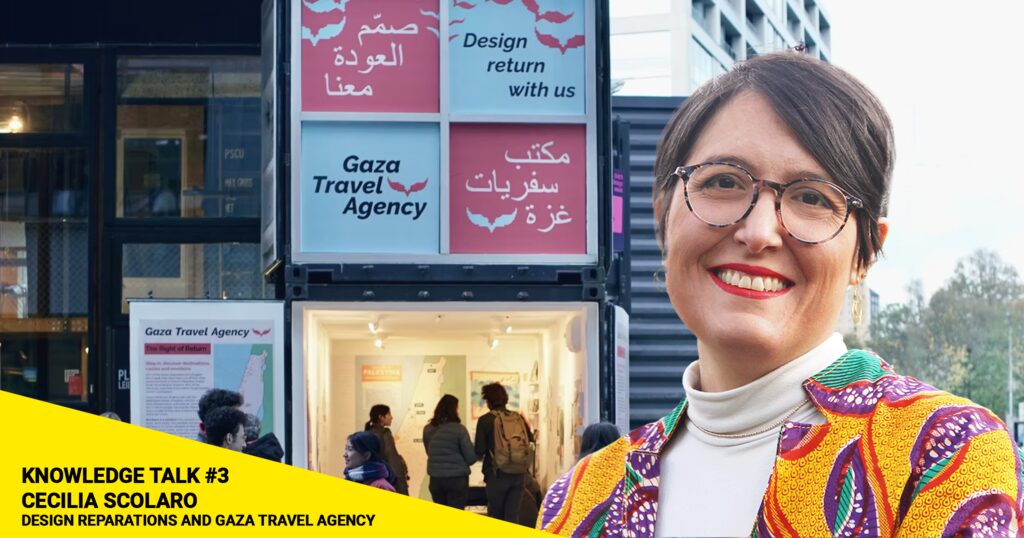
Cecilia Scolaro, co-founder of Design Reparations on the Gaza Travel Agency – Knowledge talk #3
- Knowledge Talks
Introduction
In this Knowledge Talk, Cecilia Scolaro and Tiago Paes Vilas Boas from Design Reparations share the powerful story behind the Gaza Travel Agency: a speculative design project that took over Dutch Design Week 2025.
Transcript
Introduction
Medha: We’ll begin now and if people join then they can catch up from there. Hi everyone, thank you so much for joining in. It’s always so lovely to see all of your faces. Sorry that my face isn’t on because my internet is being very unruly since I came to Upstate New York, so please bear with just my voice.
For today’s Knowledge Talk we have with us Cecilia Scolaro. Please direct me if your name pronunciation isn’t good. Great, today I think everyone knows about Gaza Travel Agency a little bit, but we’re going to be exploring it more in detail.
Before that, I want to give a very quick intro about Cecilia Scolaro, who is a designer, educator and consultant working in responsible design with more than 20 years of experience helping teams design with greater care, equity and awareness. She co-founded Design Reparations, a practice exploring how design can heal, repair and restore rather than extract and exploit, and works to build more caring, reciprocal and decolonising relationships between designers and indigenous communities. Her work spans humanitarian contexts, community-led design and experiments in shifting power within design processes.
Today, she’ll share her reflections from Design Reparations and one of its projects, Gaza Travel Agency, a speculative design piece presented at Dutch Design Week 2025. She’ll also discuss why these approaches matter for humanitarian designers.
We’re also joined by Tiago today who’s driving, so I’m not going to bother you, Tiago, with your introduction, but just a little bit on Tiago: he helps bridge design and decolonisation and regeneration to nurture and activate the emergence of equitable systems and reciprocal relationships. He also has 20 years of design expertise with 12 in social impact. We’re very happy to be joined by Tiago today, even during his most busy times. I leave it now to you, Cecilia, to start off with a very brief introduction on your journey into this field before we dive into Design Reparations and Gaza Travel Agency. Passing now to you. Thank you, Cecilia.
A Journey in Responsible Design
Cecilia: Thank you for the nice introduction. Lots of you know me, but I put together some slides. I’ll talk more about my journey in responsible design first, and then in Design Reparations and how we got to Gaza Travel Agency. I’ll share my screen.
The point of today is walking you through my journey from responsible design to Design Reparations to Gaza Travel Agency. As it was mentioned, I have 20 years of experience. I’m turning 43 in a couple of days. My pronouns are she/her and I’m an Italian living in the Netherlands for 17 years. I worked in many different spaces.
Everything is designed to be quite accessible. If you have any need, you can always get in touch with me. There are a couple of things I mentioned that are not really nice, like climate collapse, marginalisation, colonialism. Make sure you take care of yourself and some of this content may make you uncomfortable. I invite you to explore that discomfort. This is collaborative; I put together some slides, but feel free to interrupt to ask questions and participate as you like.
As I mentioned, I worked in very different areas of design. As I often say, there are as many design labels as there are designers out there because everybody picks different flavours. I explored a lot of them. It’s been a lot with the initial assumption that I was solving problems, that I was making life better for people. But the more I was designing, the more I started to see that design was not just solving problems, but was also contributing to over-extraction.
Does anybody know what the Earth Overshoot Day is? Do you want to explain it, Cédric?
Cédric: Yes, so the Earth Overshoot Day corresponds to the ability for the planet Earth to create resources versus the time it takes for the entire human population to use those resources. We say that normally, we shouldn’t consume more than what the planet Earth can generate, but it happens that since 1973, we are spending more than what the planet Earth can generate; and it goes faster and faster. We see that nowadays, in July, we have already use the entire resources that the planet Earth could generate within one year.
Cecilia: Exactly. This blue line indicates the time of the year when we have finished the resources that have been regenerated for that year. The rest of the time of the year we are borrowing from the future. This is also a global average because this day looks very different if you are analysing the Global South. This day is much earlier if you are taking the Global North; the UK, for example, is as early as the 20th of May.
This over-extraction is also causing social disparity with people extracting cobalt for all the technology that we design. Design is also often providing a tech-driven imagination of the future. This picture on the left was taken yesterday by my colleague Jessica who went to an event for social impact entrepreneurs. The whole thing was designed around how to deliver more impact with AI. There is this idea that the future is better and the future must be technological and that it doesn’t take into account the impact that all of this technology has. It’s essentially a narrative that we have been told because there is no actual proof that technology does improve all of our lives. It actually creates a lot of trash and extraction.
I cannot find more recent numbers, but in 2023 there were 29 billion devices connected to the internet, including machine to machine. For each human being there are at least three or four devices on the earth and they all become trash. On average in one year in Europe people have around 22 kilograms of e-waste produced every year. That is extremely toxic and most of the time is shipped to the Global South.
Does anyone know about the nine planetary boundaries? I will try to explain. In 2019, the Stockholm Resilience Centre measured the health of our planet, how healthy the ecosystem is for our existence as human beings, with nine criteria.
Out of the nine planetary boundaries, which has been recently updated, we currently have overshadowed seven of them, of which climate change is just one. This is also fed by this idea of infinite growth: continuous economic growth, expansion, scaling, better, bigger, stronger. That is also in the SDGs; the Sustainable Development Goals number eight: decent work and economic growth. That idea is permeating in everything that we do.
It’s a short oversight of how design practices and methodologies are all connected to power, extraction, control, supremacy, separation and externalisation of impact. That’s one of the key realisations I had in my own journey as a designer. One of them has to do a lot with colonisation and specifically how design contributes to imposing Eurocentric perspectives. If you look at these pictures on the left, like a Missoni pattern used in fashion design or a Gucci pattern is called “design”, but a Ghana traditional pattern is not normally called “design”. It’s called folkloric, folkloristic or craft. A chair of Marcel Wanders is called “design”, but a Balinese or Javanese chair is not necessarily called “design”.
What we call design and what is included in the practice is often moved by Eurocentric perspectives, which also mean the idea of individual creative genius. Because we have all of these ideas in the design space, there is someone who has all the ideas and they can solve all the problems. If you Google greatest innovators of all time, you find all of these people and in 90% of cases, you’re looking at white men.
If you look at other contexts, like the Aboriginal communities in Australia, there is a completely different idea of creativity as a collective activity, as a collective consciousness and the expression of collective consciousness through art. The last example for today, design has this idea of universal intellectual property compared to what is considered local knowledge. That’s particularly true in the humanitarian sector, where traditional indigenous practices are only seen in their local application. They’re seldomly seen as universally applicable. Instead, everything that comes from the Global North is automatically considered as universally applicable. That is really applicable to the science of design.
Defining Responsible Design
Cecilia: All of this to say that there aer a lot of systems that have informed the way design, the humanitarian and development sectors work. For me, it has been a journey of trying to understand the systems and see how they were showing up in my own design practice. I define responsible design as a way of prioritising respect, equity and regeneration in the design of everything and moving away from these extractive systems.
It starts from looking at the impact that design can have from an individual, a collective and an environmental perspective. It is a very common way of slicing it, but it doesn’t mean it’s the only way to do it. It has identifying which potential negative and positive impact the design that you are creating had. It means holding abundances of realities because the practice of responsibility means being able to accept the negatives and understanding the historical injustices, the ongoing harms that people are still experiencing. At the same time, supporting the positive and designing for self-determination, regeneration, and repairing; where the one without the other becomes either toxic positivity or complete lack of action. The two things are necessary at the same time.
If you do change your system of reference and move away from colonisation and extraction and you centre decolonisation, equity, ecocentrism, regeneration, humility, and interconnectedness, and so on, then you can explore different practices of design. This is a visualisation I worked on over the years that maps different practices that are out there, connected by similar principles. They go from privacy by design to trauma-informed, to equity and justice, to circular design. Somehow they share a lot of the principles and practices, and that’s the definition that I am personally using for Responsible Design.
All of this is an overview of what responsible design is and what and what has meant, for me, becoming an educator. My learning journeys are available on my websites. You have seen a glimpse of what Foundations of Responsible Design is and you can access a special Humanitarian Designers discount if you want to look at the learning journey available.
Design Reparations
Cecilia: This brings me to Design Reparations. One key aspect I analysed is colonialism and how much that shows up in design practices. In this journey, I met Tiago, who is also a designer thinking about ways we could evolve design practice and who has worked a lot with indigenous people. When we met at a networking event, I was like, “Let’s have a workshop for my students, it would be very nice.” The things evolved quickly.
Why do we talk about indigenous people in the first place? It’s because, it has been calculated that indigenous peoples steward 80% of the world’s most biodiverse regions. Effectively, the way of living and relating of many of these populations is what keeps our Earth healthy and alive and good for everybody to live on. We start from this important assumption that there is so much wisdom in this way of living, thinking and designing. As designers from all over the world, there is a lot we can learn from them. At the same time, we are very much aware of not willing to replicate a system of extraction and just get knowledge out of them and applying it somewhere else.
That’s how we came together and we shaped Design Reparation with this idea of reciprocity: creating a form of collaboration between designers, creatives and innovators with indigenous and ancestral knowledge holders where ancestral knowledge holders lead and guide everything that we do, but also support their own goals. Indigenous people have their own work, a lot of it in the space of climate justice and social justice. The idea is that designers can support these initiatives and at the same time learn from them different ways of being.
Tiago and I were trying to visualise how this exchange and reciprocity could take place and how design, university, institution, and organisation could support this collaboration. And it grows. Now we are working with many indigenous communities around the world: Ecuador, Brazil, Cameroon, Tanzania, Kenya, and the Philippines. These are our main partners. We have also other people that are getting in touch with us because they see the work that we are doing and they would like to get more of our support and we are struggling with the resources available. We also have a lot of designers and creatives that want to join because together we do real projects.
Some are smaller, like a workshop with Caribbean communities in the Netherlands or an online session with Princess Abumbi from the Bafut community in Cameroon. Some are bigger, like Kenge Content Hive. We’ve been partnering since last year with the Samia community from Lake Victoria in Kenya. Their main purpose was climate resilience and regeneration in their community. We started working with them and exploring their traditional practices. We learned that new generations were getting disenfranchised and disconnected from their traditions moving to the city, they didn’t care anymore. We decided to interview elders. You can see a picture on the slide. We took these interviews and created a series of ways to share it: in the first place with the local community but beyond that as well, so we have a series of videos that you can check on YouTube, a book and comics for local youth. We organised a workshop between the elders, the youth and the local government to discuss climate change and how traditional practices could help the community. With part of this, we went to Nairobi Design Week and started trying to engage designers in the conversation and let them be inspired by their own tradition and roots, and not just living the expectation that they have to create something completely new whenever they design something. Innovation can also be an act of remembering whatever our ancestors were accustomed to do.
Gaza Travel Agency
Cecilia: Gaza Travel Agency was born to support an indigenous community, which is the Palestinians. It is of course a very special community, because most of the people you see on this picture are Palestinians, but only a couple grew up in actual Palestine; most grew up in Kuwait, Syria, Emirates and everywhere in the world. But they still call themselves Palestinians and have an important need to be able to go back to their ancestral place. That’s how they approached us.
Around the end of 2024, this group of Palestinians in diaspora and Jewish people were coming together to advocate for the right of return. There were leaked documents that were saying that Israel was trying to expel Palestinians from Gaza and bring them to Canada or DRC or somewhere else in the world. So they wanted to expose these plans and trying to bring back the conversation on the right of return, which is a legal human right granted to the Palestinians since 1948 but has never been delivered. The Palestinians, since 1948, are being told “yes, you will be able to go back to your original home”, but that was never possible. They came to us with, “We want to make a media campaign. We want to be very visible.”
We put together a team of designers and volunteers, and we really started from a design perspective of thinking: “Who do we want to talk with?”. We realised we wanted to make something that talked about return in a very hopeful and positive manner, also to break a bit this idea that everything associated with Gaza and Palestine must be about death and destruction which is an important topic to talk about, but it cannot be the only one. We played with a lot of ideas and we found in the Keffiyeh, a traditional scarf of Palestinian culture, this symbol that are supposed to be olive tree leaves. But we looked at them and said, “They also look like a bird; and a bird can fly; and a bird can always know where home is”. We embraced this shape of the bird and these pastel colours to explore and talk about a very important political message, but in a very hopeful and joyful manner talking about home as a universal need
Somewhere in April, someone from the team said, “Why don’t we go to Dutch Design Week?” because that is where the elite goes, and the elite is somehow the target audience that still hasn’t embraced the Palestinian struggle yet. That also tells something about the design, by the way. As a matter of fact, we were the only exhibition in the whole Dutch Design Week in 2025, which is very large, completely dedicated to Palestine.
We decided to look for a space and it was already quite late for normal planning, but there were a lot of people that really wanted to help us. We got this container for free in Strijp-S, which is right at the centre of Dutch Design Week, and we set up Gaza Travel Agency as a speculative design project. The idea was: what would be a future where something like this can happen and people from Gaza can just enter a travel agency and plan their return home? We had stewards, a mix of Palestinians and international people, which were ready to welcome people inside and give them a tour.
All the little dots on the map are places that were ethnically cleansed in 1948. Ancestral Palestine is now called Israel. 750,000 people were pushed from all these places into Gaza. 80% of the people in Gaza are refugees or descendants from these places. Most of these places remained completely empty ruins because Israel didn’t find enough people to fill them. Given the circumstances of Gaza right now, we wanted to bring back the right of return as the solution for all of this situation instead of sending Palestinians elsewhere in the world.
We had a selection of destinations, like a real travel agency and for each destination, we had identified a way to get there. You could go to Al-Ma’in by bike because it’s only five kilometres away from the border of Gaza. You can go to Ikrit, which is the furthest away from Gaza and close to the border with Lebanon, with only five hours of bus ride. You could go to Lydda by plane because Lydda used to be the airport of Palestine and it’s now Tel Aviv airport. For each of these location, there is a portrait and a Palestinian’s story. One of the important people connected to these places is Salman Abu Sita, a researcher who is originally from Al-Ma’in and who started writing about the right and the plans for return already 30 years ago. These plans are detailed and feasible. Return is very easy from a logistical standpoint. On the background of everything, there is small text covering the whole container: a collection of all the UN resolutions and pieces of international laws that have supported the right of return since 1948. This gives you an idea of the experience that we had and we also had very positive reactions and interactions with people.
We had 6,400 visitors in total. Many people said, “I didn’t know about this. This really makes a lot of sense. I don’t understand why nobody is talking about it”. It was addressing people who were not necessarily active for Palestine, but they walked out with a different perspective. “Trouw”, one of the largest newspapers in the Netherlands, wrote several articles: one article about us online but, most importantly, one about the right of return and Abu Sita’s plan. Abu Sita is now about 88 years old. Our goal of bringing the right of return into the mainstream conversation was achieved.
One of the very nice outcome that we didn’t plan is that a lot of Palestinian people got to know each other more, because a lot of them didn’t know other Palestinians in the Netherlands; it created a sense of community, and that was beautiful to experience and to support.
We are trying to do more projects like this one and engage organisations to support projects of reimagination, using indigenous guidance to think and reimagine more just and ecological futures. And also projects of transformation where we can help companies and non-profits organisations be inspired and guided by indigenous wisdom. If you are interested, you can check our circles, we always have openings for volunteers. You can follow us on Instagram: Design Reparations and Bring Gaza Home. You can also get in touch with me.
Discussion and Q&A
Medha: Thank you so much, Cecilia. That was such a thoughtfully curated presentation. I deeply enjoyed it. I think this was my favourite one so far. I really loved how you began and how you built up to Design Reparations and then Gaza Travel Agency. And thank you for the animations Gwenn; I don’t know how you’re doing it, but it’s very cool.
I personally have a question before I open up the floor. I deeply resonated with what you shared today about colonisation and design. I was studying in a Master’s programme where much of the faculty was from the Global North. I found it quite hard to communicate my ideas, even though it was an open and friendly space and we were encouraged to bring our ideas, my thesis was on decolonising education through the lens of the Vedic education system. This is an Indian-Indigenous education system which persists to this day, but not as it used to be before we were colonised by several empires.
It was hard to get across the idea of the Indigenous education system even though I was in an education setting. Even though it seemed like we were all using the same buzzwords like “decolonisation,” I would like to ask you how do you communicate to people your ideas when everyone is using the same words but maybe they’re not in the same realities? You spoke about an abundance of realities. How do you communicate and bring people into the same reality so you’re on the same page?
Cecilia: That’s a very nice question. Our starting point is establishing relationships because we believe that if you get to know different ways of being and knowing, and you get to know people that carry those, that’s going to become apparent. Each of us carries some level of indigeneity or connection -or lack of which is also something that you can feel- with the land and our roots. When you work with people who have those roots, it becomes self-evident that there is so much you can learn.
Rather than going from a rational explanation of why you should do it, we tend to create the opportunities for that conversation to happen. Of course, that’s not always easy to get started; that’s the challenge we face. But at the same time, we are very keen on trying to create safe spaces for our indigenous partners. We make sure that wherever we bring them in, they’re not going to be suffering aggressions, microaggressions, or extraction by people who didn’t have enough scrutiny in their own colonial mindset. Tiago, do you want to add anything?
Tiago: Thank you everyone for being here, it’s my first participation in this community. I want to thank Medha as well for the introduction. I think we are relating all the time with everything we are ecosystems as well, what sustains us, the foods, the organs, and so on. What we are trying to learn with the people we are in relationship with, and with these communities as well, is a type of relationship that we see in nature that it is a mutual exchange, it is a caring relationship, which is very difficult to bring into a transaction world that we live in run by markets and capitalism.
For me, being with people from different places feels like establishing a connection again with a human being, which is very difficult to do. We are learning how to do this in different spaces. I think what we have been robbed of in this new area that we live in is trust. It is about establishing trust and naming what is stopping us from having this mutual and reciprocal relationship where we get and give back with respect.
I think that’s the “reparation” we try to talk about. That’s one of the reasons we started Design Reparations: really to repair this. Repairing something that is already broken is almost impossible for many people, they tell me, “How can we repair this relationship?” It’s made in a way to transform, but the reparation still is there as a call out to first reflect on that.
Medha: I think that beautifully answers my question. Thank you so much Cecilia and Tiago for bringing up that relationality and trust. And maybe just giving more time would be helpful in showcasing different realities to different groups of people in bringing us together. I open the floor for questioning and answers.
Beatrice: Hi, I have a question. You were saying the Bring Gaza Home project was a big success, which is brilliant. I’m just wondering, as there’s a huge need for awareness on that topic in the design world, are you planning on bringing that project or any other to design weeks next year?
Cecilia: It’s a great question. That was a common question we got: “Where are you bringing this next?” We are exploring different places. We can bring it beyond the design weeks, because the target audience we are trying to reach is the average person who is not necessarily a designer. Dutch Design week is very specific because it is welcoming of different thinking. Not all design weeks would be good for the Gaza Travel Agency. In general, we are looking for more places and trying to make it sustainable; everything you’ve seen was produced with a lot of donations: everything printed was donated by print shops; we had 30 volunteers working on it; every object and location was donated by someone. It was a lot of work in terms of coordination. We are trying to figure out a sustainable way of bringing it forward. But, yes, it’s what we are planning to.
Medha: Thank you, Beatrice. Is there anyone else? Hossam, I think you might have a question.
Hossam: Yes, please. First of all, I want to say thank you so much for this. I think not only the presentation, but the project itself is really important. It’s one of the most important projects I’ve seen on Gaza in the last two years. I already told you before. I have one question that I’m a bit confused about. Do you have the level of time as one more dimension to track indigeneity? I’m not sure if this is the correct word or not, but how long have these people been living there to be considered indigenous in this case? Because a lot of the time, this is the argument that people raise; although they have been there for 100 years or something, it is not considered indigenous. I wonder if you add this dimension of time as well.
Cecilia: It’s a great question, and also something that we’ve been debating a lot about: what is indigenous in general, besides Palestine, but with everything that we work with. We recognise this word is loaded for many reasons. Not all of the people we work with necessarily define themselves as indigenous; the people in Kenya we work with were like, “Are we indigenous? Really?” Well, it depends.
The criteria that we decided to apply is the connection with the land and the connection with the ecosystem of the land. In that sense, I can tell you that all the Palestinian people we have worked with can tell you exactly the plants and the fruits that the land bears, and the traditions in their culture that are connected to the geography, to the rivers of the place. So in that sense, it’s what we use as a definition.
That doesn’t exclude people that feel that connection and also seek cooperation. One of our key partners for the travel agency is Zochrot. Zochrot is an Israeli organisation committed to the return of Palestinians and the human rights of Palestinians, and of all the beings that live in that land. So it’s not a matter of time; it’s a matter of relation.
Tiago: Indeed, what Cecilia said that people don’t see themselves as a group. If you ask someone from Amazon, they see themselves as the name as they define themselves as people. The indigenous part in some cases has been used as a label put on us by colonisers, so there is an intention and a tension also in people claims. I was in a meeting where a guy, I think he was German, who was working with people in Brazil was claiming to be indigenous himself, and it wasn’t good, I can tell you that. So it is complex for us, it is not so much for us to define. I think we want to give voices to those whose voice and culture have been erased and silenced through colonial processes and state projects.
Cédric: Thank you for the presentation. You said that at Dutch Design Week you applied under speculative design. Was that forced in order to fit in the program, or were there categories where you could show more activism? For example, with Humanitarian Designers, when we applied to France Design Week, there was no “social design”, no “strategic design” or “humanitarian design.” Did you have conversations with Dutch Design Week about those things, and were you able to change how they work by bringing your values?
My last question is about the circles: how did they emerge? Are they opportunistic in the sense that someone shows up motivated, or were they very targeted because you had a personal attachment?
Cecilia: On the first question, we approached the whole thing with the assumption they would not let us do it. We thought someone was going to stop us, boycott us, or even be physically violent, so much so that I took a special insurance and I organised non-violent communication training for everybody beforehand.
When we approached Dutch Design Week, we asked “Okay, before we fill out the form, we have this idea. If you think it’s viable, we fill out the form; otherwise, we don’t bother.” We were actually surprised by the fact that everybody was supportive. Of course, they were a bit cautious at the beginning because whenever you bring up Palestine, people ask, “What is it that you’re bringing?” We chose speculative design because we wanted to explore that speculation, that was very much our intention because we felt it strategically was a good way to enter a conversation with people, but also to be recognised by designers because most people in the team never heard about speculative design. I had to explain them where it came from. Sometimes, we use these bubble terms.
The organisation of the Dutch Design Foundation was very supportive; they even included us in the press tour of the Dutch Design Foundation. We had no expectation, to be honest, but it was overall positive. Sometimes we have a lot of labels, but it doesn’t actually matter to the public because the people coming in didn’t care if it was “speculative” or something else.
Regarding the circles: the sad truth is that the first circle we wanted to have was with Cameroon. We had a full project ready, and then we found a grant for collaboration with Africa, but Cameroon was not on the list because there is a civil war going on. So we had to look for other relationships in Africa and Tiago found Kenya. Let’s say that we tried to put intention, but there are a lot of factors that influence the projects: funding, availability, etc. We decided that while there is a lot of work done for indigenous people in North America or Australia, and New-Zealand which are very well organised and we probably cannot add too much value, but there is relatively less work for communities in Africa, South America, and Asia. That is the criteria we applied.
Tiago: I think it makes me think about something that we talked about regarding these projects, especially with Kinga as well: how much we use the term “community-led” or “indigenous-led.” It means that if you’re going to do a project, we need the people that we are working with to lead the project in a sense. In many ways, sometimes we have to be together because there is no organisational structure or process.
We also need it to be open to learn from them and understand, but it is complex because if you’re talking about grants, grants also ask something from them. And we found out that our partners, sometimes they are people, like unicorns, that worked hard but also had privileges to get where they are, to be able to navigate between the communities where they live and all these systems that ask for grants and aid.
It’s complicated because sometimes we get an invitation from someone who doesn’t yet have an organisation or doesn’t even have people to help take on the project. So there’s something to think about: how we could support communities like that so they could partner with others who have more people to work on the project.
Also, sometimes the projects we’re working on can only go so far; it will depend on the partner. We call them “partners” because they ask us to call them partners, but the invitation is that we are really learning how to not be on the “front seats”, which is, again, perpuetuating the colonial structure, which we are also asked about: “Are you being like a gatekeeper?” It sounds like that, but then we reflect. I know, for example, Kinga, or another organisation in Malawi, or in the case of Cameroon, there is a blockade of aid and projects going to the country because of the genocide, but also the government. The systems there are really isolated. So I think: okay, how can we find a road to connect, but how do we do that in a way that is responsible? I’m just leaving a question here in the reflection.
Medha: Thank you so much Tiago and Cecilia. I think that was a perfect question to conclude our Knowledge Talk session today on. I personally think that if you all want to continue having a discussion and having some more reflections together, then I urge all of you to please continue. However, I definitely have to drop off now due to some other commitment.
In view of that, I want to thank both of you today. Thank you so, so much for all of your thoughtful work. You’re doing extremely important work. And what I love, what I’ve heard from everything today, is how you’re able to bring people together. I love the fact that you said there were Palestinians in Netherlands who have met other Palestinians and now, through you, they were able to come together. I’m sure that’s the story for all of your other projects as well. So it’s amazing what you are bringing to the world. Thank you Gwenn for bringing these animations. Please continue chatting if you want to. Good bye.
Cecilia: Thank you, Medha, for organising and thank all of you here. You know where to find us for everything else. And we hope to see you in our circles and our projects in the future. And thanks also to the Humanitarian Designers who were an important partner for Gaza Travel Agency.
Cédric: Incoming workshop, maybe Incoming workshop in collaboration, that would be nice.
Cecilia: We are very keen on organising workshops and finding more opportunities. And we also find it super important that our partners get paid. So that’s what we want to ensure. Thank you, everybody. Hope to hear from you soon.